"Support the leadership team, drive cross functional alignment, own reporting and ensure operational excellence."
Plenty of job descriptions contain a line like that. Nothing in it is wrong, but try writing an interview question from it. What does operational excellence look like on a Tuesday? How would you know whether someone had done it before?
In our last article we looked at how to describe the result a role needs to produce. Once you know the result, the next job is to describe the work that gets you there, in a form you can see and test.
A useful role brief separates that work into four categories: recurring work, projects, decisions and stakeholder interactions.
Why a list of responsibilities is not enough
A list treats everything as the same kind of thing. Weekly invoicing sits next to leading a system change, even though they call for very different people.
Human resources teams that write these documents for a living push against this. The University of Windsor's guide to writing job descriptions lists "analysis not lists" and "functions not tasks" among its key principles. Tennessee Tech's job description toolkit asks writers to explain why, how, where or how often each duty is performed.
The four categories below are a simple way of doing that analysis before you start a search.
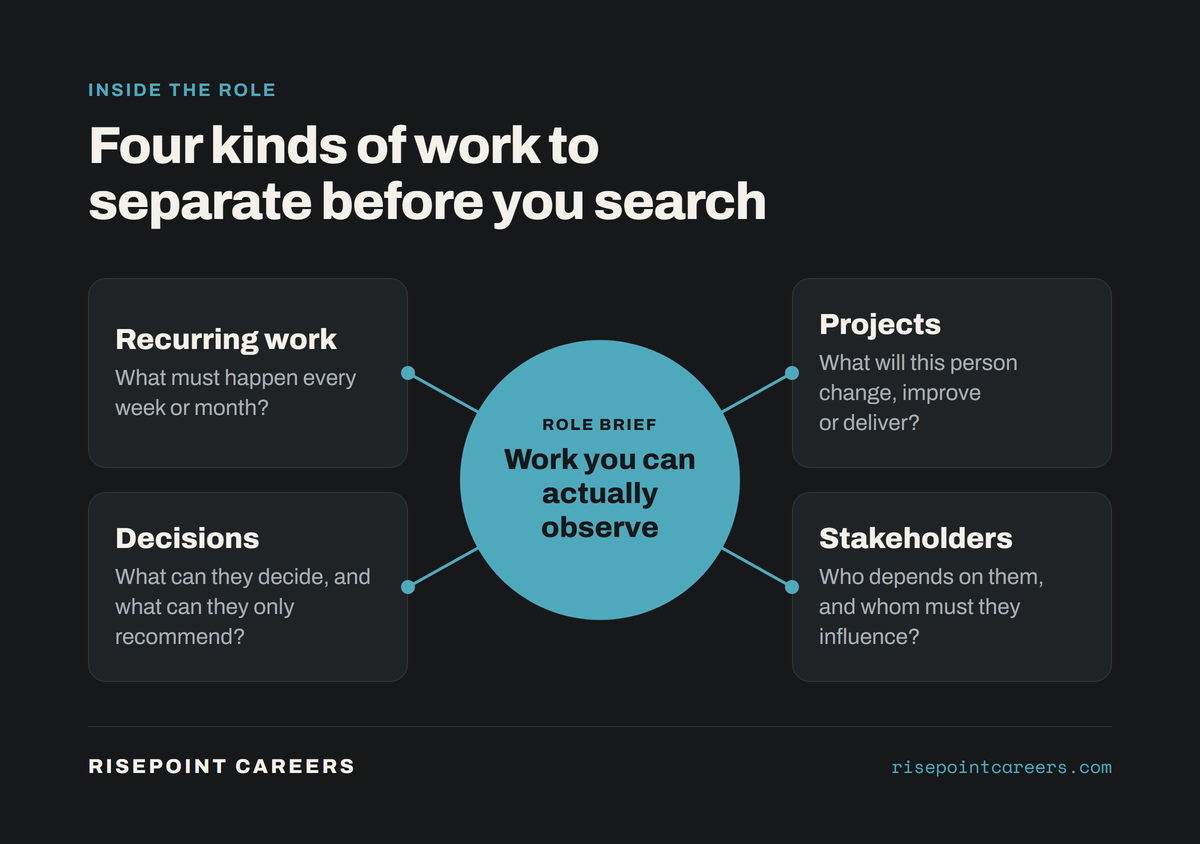
1. Recurring work
This is what must happen every week or month, whatever else is going on. Payroll runs, stock counts, client reports, month end close.
Write down the task, how often it happens and what goes wrong if it is late. Then estimate how much of the year it takes up. Both Windsor and the University of Oregon's position description guide ask for this kind of share of time, and it is worth doing even as a rough figure. A role that is 70 percent recurring work needs a different person from a role that is 70 percent projects, even if the two have the same title.
What to look for: evidence of sustained execution. Someone who did something well once has not shown you this. Ask how they kept a routine running for a long period, and what they did the month it nearly failed.
2. Projects
These are the changes, improvements or deliveries the person will lead, each with a start and an end. Moving to a new payroll provider. Opening a second site. Rebuilding the client onboarding process.
Name the two or three you already know about. If you cannot name any, that is useful too. It may mean the role is mostly recurring work, and the job description should stop asking for a "change agent".
What to look for: a project of similar size, and what the person personally did on it. Group achievements are easy to claim, so ask which decisions were theirs and what they would change.
3. Decisions
This category is the one most often left out, and it is often what separates a junior role from a senior one.
Windsor's guide has a separate section for it, split into decisions the role makes and recommendations it makes, and it asks whether each is made independently or with others. Oregon's guide adds the type of decision, such as financial, personnel or operational, along with the impact and the level of independence.
For a small company, the practical version is short. What can this person decide alone? What can they only recommend? How much can they spend without asking?
Answering this can expose a real problem. If a founder wants a senior leader but intends to approve every purchase, the role is not senior in practice, and a strong candidate will find that out quickly.
What to look for: if the role requires difficult decisions, ask for an example of one. What did they know at the time, what did they choose, and what happened?
4. Stakeholder interactions
Who depends on this role? Where must this person get things done without any direct authority over the people involved?
Tennessee Tech asks writers to describe the nature of each contact, who the people are and how much interaction is involved. That level of detail matters, because "works with sales" could mean a monthly email or a weekly negotiation over priorities.
What to look for: if the role needs coordination across teams, ask how the candidate created agreement among people who did not report to them, and what they did when someone refused.
Turn each category into evidence
Once the work is split up this way, the interview plan is mostly written. Each category gives you at least one thing to assess, and a question that links directly to the job.
The US Office of Personnel Management recommends that interview questions be tied to competencies identified through a job analysis. It suggests asking for a specific past example, such as the most recent or most difficult time a person did something, and listening for the context, what they did and the outcome.
There is a practical reason to bother. OPM's overview of structured interviews says that interviews with more structure show higher validity and more agreement between raters. In plain terms, interviewers are more likely to agree with each other, and the result says more about the job.
The clearer the work, the less your team has to rely on impressions.
How to do this in under an hour
Sit down with the hiring manager and, if you can, someone who has done the work. Windsor's guide suggests asking staff for their key functions, their share of time and the decisions they make without guidance. Take four sheets of paper, one for each category, and fill them in.
Then cross things out. Anything that does not fit a category may be there out of habit. Oregon State University's position analysis guidance calls accurate and necessary qualifications crucial to a successful search, and the same test applies here. If a requirement does not connect to any of the four sheets, ask why it is there.
The bottom line
A role is easier to hire for when you can see the work. Separate what recurs, what will be delivered, what must be decided and who must be influenced. Then ask candidates for evidence of each one. Four short lists will tell you more than a page of general responsibilities.