Ask most people when hiring gets complicated and they picture a large company: a recruitment team, an applicant tracking system, approval chains and policies.
In practice, hiring becomes difficult much earlier. It becomes difficult the moment several people need to make one important decision together. A company with twelve employees can reach that point with its very first hire.
Small companies are where most hiring happens
This is not a niche problem. According to the US Small Business Administration, small businesses employ 45.9 percent of American workers, about 59 million people. In Canada, small businesses account for 46.8 percent of the private sector workforce, according to Innovation, Science and Economic Development Canada.
Nearly half of all hiring decisions, in other words, are made by organisations that have no recruiter and no dedicated hiring team. The work still has to be done. It is simply spread across people who all have other jobs.
Complexity comes from people, not headcount
Picture a small company hiring its first operations manager.
The founder understands the commercial need. The manager who will work with the new hire understands the day to day work. An office administrator books the interviews. A senior colleague is asked to test technical depth. Each person holds part of the picture. Nobody necessarily owns the whole process.
That is the real source of complexity. It is not the size of the company. It is the number of decisions, handoffs and pieces of evidence involved. Four people sharing one decision creates the same coordination problem whether the company employs ten people or ten thousand.
Where small teams lose good candidates
When nobody owns the full process, the same problems show up again and again.
Delays nobody notices. The founder assumes the manager has replied to the shortlisted candidate. The manager assumes the administrator did. A week passes. A strong candidate accepts another offer, and nobody can say exactly when the process stalled.
The same questions asked three times. Without a shared plan, every interviewer covers the same ground. The candidate spends three hours answering "tell me about yourself" and leaves with no sense that the team knows what it is looking for.
Different standards in different heads. One interviewer is judging technical skill. Another is judging culture fit. A third is judging whether the person would be easy to manage. Each gives a confident opinion, and the opinions cannot be compared because they measured different things.
Evidence scattered everywhere. Notes sit in a notebook, an email thread and a messaging app. When it is time to decide, the loudest recollection wins.
None of these problems requires a large company. All of them cost small companies the people they most wanted to hire.
What small teams actually need
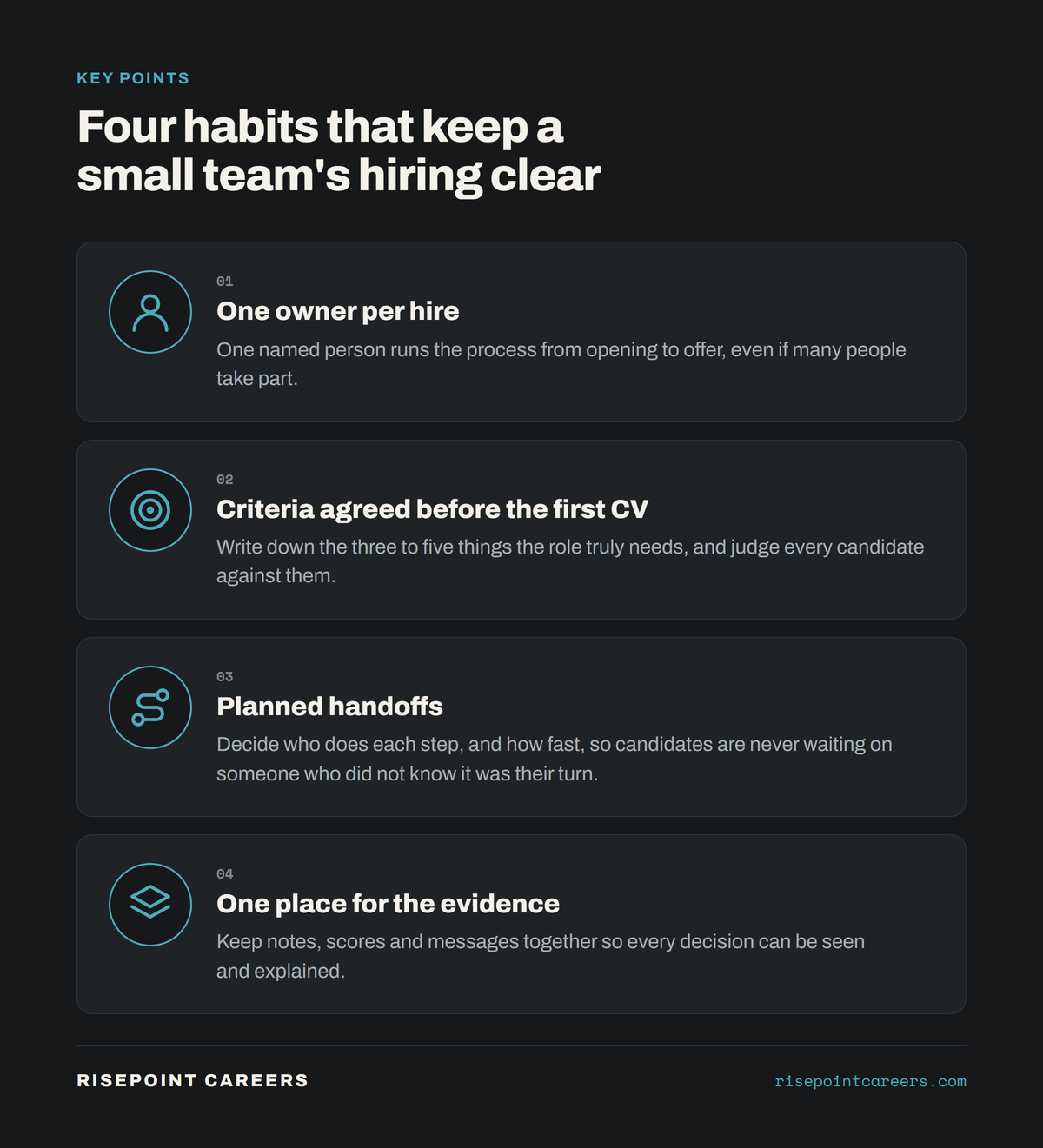
The fix is not enterprise bureaucracy. A twelve person company does not need approval chains or a forty page hiring policy. It does need four simple habits.
1. One owner for each hire. Name one person who is responsible for the process from the moment the role opens until an offer is accepted. Other people still interview and give opinions. The owner makes sure every step happens and nothing waits without a reason.
2. Criteria agreed before the first application arrives. Before anyone reads a CV, write down the three to five things the role genuinely requires. Be specific. "Strong communicator" is hard to assess. "Can explain a supplier delay to a frustrated customer without escalating it" is not. When everyone judges against the same short list, opinions become comparable.
3. A structured interview. Give each interviewer a different part of the criteria to cover, and ask every candidate the same core questions. The US Office of Personnel Management describes structured interviews as asking all candidates the same predetermined questions and rating every answer against the same scale, so that people are assessed accurately and consistently. A small team can do this with a one page document.
4. One visible place for the process. Every candidate, note, score and message should live in one place that everyone involved can see. That can be a simple tool or a well kept shared document. What matters is that nobody has to piece the story together from memory.
A quick before and after
Here is the same hire run two ways.
Before: the founder posts the job, forwards CVs to two colleagues, and asks them to "have a chat" with anyone who looks good. Three weeks later the team meets to decide, and finds that each interviewer met a different set of candidates and asked different questions.
After: the founder owns the hire and writes down four criteria on day one. The manager covers two of them in a first interview, the senior colleague covers the other two in a second. Everyone records a score against each criterion in the same shared place. The decision meeting takes twenty minutes, and the team can explain why it chose the person it did.
The second version is not more bureaucratic. It is simply clearer, and it is also fairer to the candidates, who get a process that respects their time.
The candidate feels the difference
Disorganised hiring is not only an internal cost. Candidates notice slow replies, repeated questions and vague feedback, and they draw conclusions about what working for the company would be like. For a small employer competing with larger brands, a clear and respectful process is one of the few advantages that costs almost nothing.
The bottom line
Your company can be small and your hiring can still be complex. The complexity comes from people sharing a decision, not from headcount. Small employers do not need enterprise processes. They need a clear owner, agreed criteria, consistent interviews and one place where the process can be understood.
If you are ready to choose a tool for that last step, we covered what a small team actually needs from an applicant tracking system in an earlier article. Start with the habits, though. A tool only makes a clear process faster. It cannot make an unclear one clear.