
Many hiring problems begin while the team is still describing the role.
It usually looks harmless. A manager asks for a familiar title. Someone finds the job description from the last time the role was filled. A list of qualifications is copied forward. The vacancy goes live before anyone has agreed on what the new person must actually deliver.
From that moment, every later stage inherits the ambiguity.
How the ambiguity spreads
Recruiters search using the signals in the ad, so they look for the wrong things. Candidates apply against expectations that were never made clear. Interviewers each test what they personally think matters. And onboarding starts with competing assumptions about what success looks like.
We have written before about drawing your hiring process before choosing tools, and about tracing one recent hire to find where the process broke. When teams do that audit, the break often turns out to be at the very start: the role itself was never properly defined.
Change the first question
The usual first question is: what kind of person do we want?
That question invites a picture of an ideal candidate. Someone with the right title, the right degree and the right number of years. It feels specific, but it says very little about the work.
A better first question is: what needs to be different because this person was hired?
The answer forces the team to talk about the job rather than the person. It produces the foundation for everything else: the title, the responsibilities, the requirements, the assessment and the goals for the first year.
Large employers start with the work too
This is not a new idea. The US Office of Personnel Management calls job analysis, the study of a job's tasks and the competencies needed to perform them, the foundation for all assessment and selection decisions. Its reasoning is simple: to find the best person for a job, you first need to fully understand the nature of that job.
The UK Civil Service takes a similar view. Its Success Profiles framework sets out five elements a candidate might be assessed on: behaviours, strengths, ability, experience and technical skills. It is clear that not all of the elements are relevant to every role, and that they vary with the profession, level and type of role. In other words, the role decides what gets assessed, not habit.
A small team does not need a formal job analysis. But it does need the same order: the work first, then the person.
Translate the title into the work
Take the title your team asked for and write it at the top of a page. Then answer four questions underneath it.
- Outcomes. What must be different in twelve months because this person was hired? Be concrete. "Month end close finished in five working days instead of twelve" is an outcome. "Strong finance skills" is not.
- Responsibilities. Which decisions and tasks will they own, and which will they share with others?
- Constraints. What is the budget, the hours, the location, the tools and the team they will work with?
- Evidence. What would a candidate need to show to prove they can deliver those outcomes?
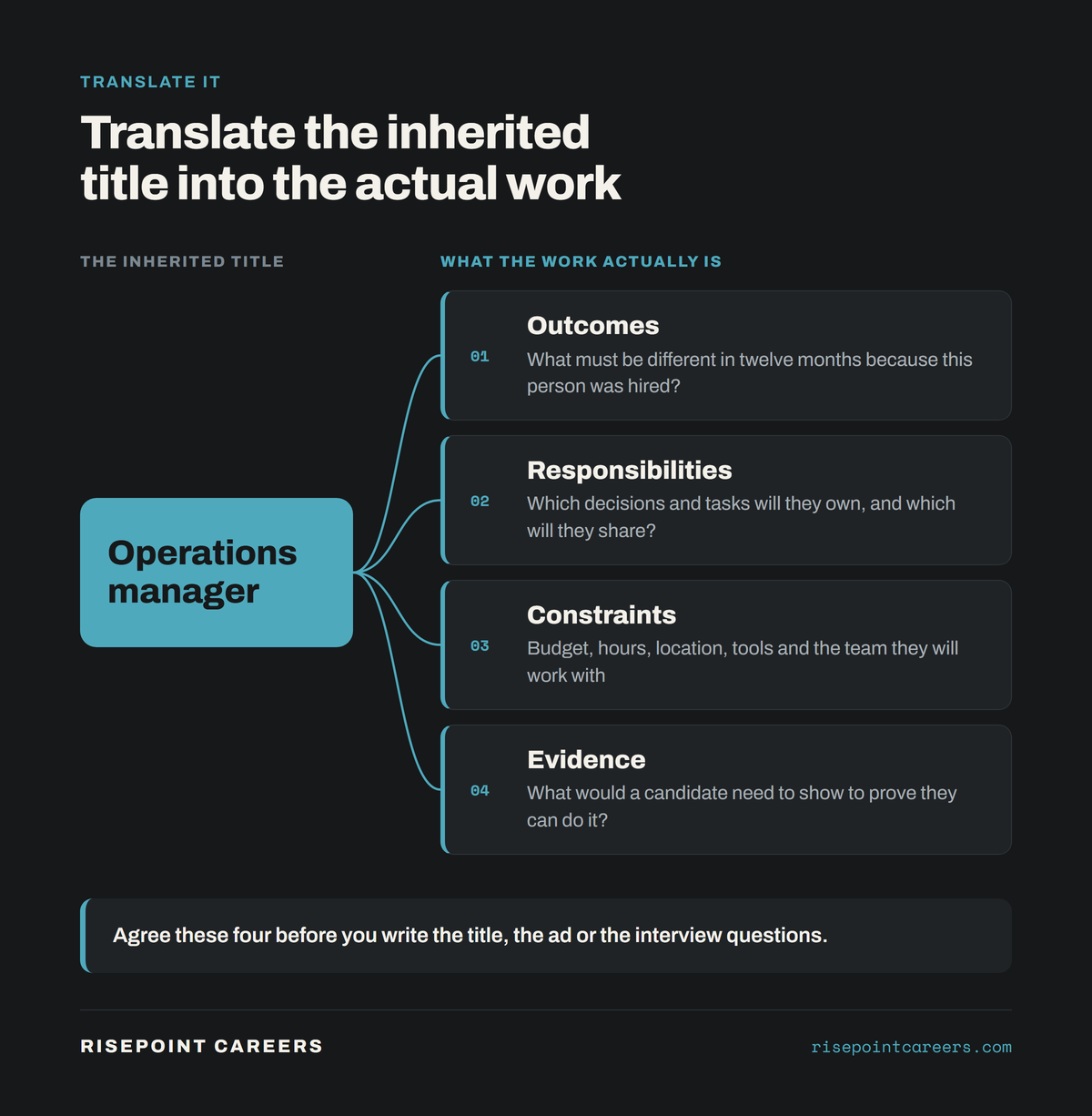
Only once these are agreed should you write the title, the ad and the interview questions. You may find the title you started with no longer fits.
Watch out for inherited requirements
Copied job descriptions often carry requirements nobody has questioned in years. A degree, a set number of years of experience, a specific piece of software.
Some of these matter. Many are habits. A joint report from the Burning Glass Institute and Harvard Business School on skills based hiring found that while many companies announced they were dropping degree requirements, sustained changes in who they actually hired remained elusive for most. Removing a line from an ad is easy. Changing how a team decides is harder, and it starts with knowing what the work requires.
For each requirement on your list, ask: which outcome does this help deliver? If you cannot name one, it is probably inherited rather than needed.
A quick example
A small logistics firm asked for an "operations manager" because the last person in the seat had that title.
When the team answered the four questions, the outcomes were narrower than the title suggested. They needed delivery complaints cut in half and a reliable weekly schedule for twelve drivers. The person would own scheduling and supplier calls but share hiring decisions with the owner. They would work on site, with an existing routing tool and no extra budget.
The evidence they needed was a track record of building schedules and reducing missed deliveries. A degree in business, which the old description required, did not help deliver either outcome. The firm advertised for a "transport scheduling lead" instead, and the interview questions followed directly from the two outcomes.
Make it a shared document
Write the answers down in one place and get the hiring manager, anyone interviewing and whoever approves the budget to agree them before sourcing starts. That one page becomes the reference for every later decision. When interviewers disagree, they can go back to it. When a strong but unusual candidate applies, you can check them against the outcomes rather than the old title.
The bottom line
The first hiring mistake often happens before the job is posted. Instead of asking what kind of person you want, ask what needs to be different because this person was hired. Agree the outcomes, responsibilities, constraints and evidence first. Then write the title, the ad and the assessment from that foundation. Define the work before you search for the person.