Most hiring processes are not designed. They are assembled while the hiring is already happening.
Applications arrive through a job board and a shared inbox. Interview times live in three people's calendars. Notes sit in personal documents and notebooks. Decisions are made in a chat thread. Follow up depends on somebody remembering what was agreed on Tuesday.
Each of those tools works well on its own. The trouble is in the gaps between them.
Where the loss actually happens
In an earlier article we looked at why hiring becomes complex as soon as several people share one decision. Fragmentation is what that complexity looks like in practice. Here are the gaps where it does damage.
The decision with no reason attached. A candidate moves to the second round. Someone agreed in chat, but the reason never makes it into the notes. Two weeks later, nobody can say what made this person stand out, and the final decision is made on memory.
The step nobody owns. The hiring manager says "we should meet her." The founder assumes the manager will send the invitation. The manager assumes the administrator will. The invitation goes out five days later, or not at all.
The candidate waiting in silence. A strong applicant is in the process, but nobody can see at a glance how long it has been since anyone spoke to them. While the team reconstructs the last decision, the candidate hears nothing.
The process nobody can improve. When status, notes and messages live in five places, there is no complete record of what happened. You cannot see where candidates dropped out, how long each step took, or why good people said no. You cannot fix what you cannot see.
The candidate notices the gaps first
The people who feel fragmentation most are the candidates. They do not see your tools. They see the silence.
A SHRM article on why candidates drop out of hiring processes reported survey findings that 47 percent of respondents named poor communication as the top reason candidates withdrew their applications. The HR leaders quoted in the same piece pointed to slow responses and long, unclear processes as the things that drive good people away.
Poor communication is rarely a choice. It is what happens when nobody can see that a reply is overdue, because the information needed to notice is spread across an inbox, a calendar and a chat thread.
Fragmentation is also a records problem
There is a second cost that most small teams only discover when something goes wrong: hiring creates records, and those records matter.
In the United States, the Equal Employment Opportunity Commission's recordkeeping requirements state that employers must keep all personnel or employment records for one year. In the UK, the Information Commissioner's Office guidance on keeping recruitment records reminds employers that candidates may make a subject access request for their information, and warns that destroying records too quickly can make it harder to show that a process was fair.
Now picture answering either of those from a hiring process that lives in five places. Which inbox holds the application? Whose notebook holds the interview notes? Was the decision made in a chat thread that has since been archived? The rules are the same for a small company and a large one. A scattered process simply makes them much harder to meet.
What one visible sequence looks like
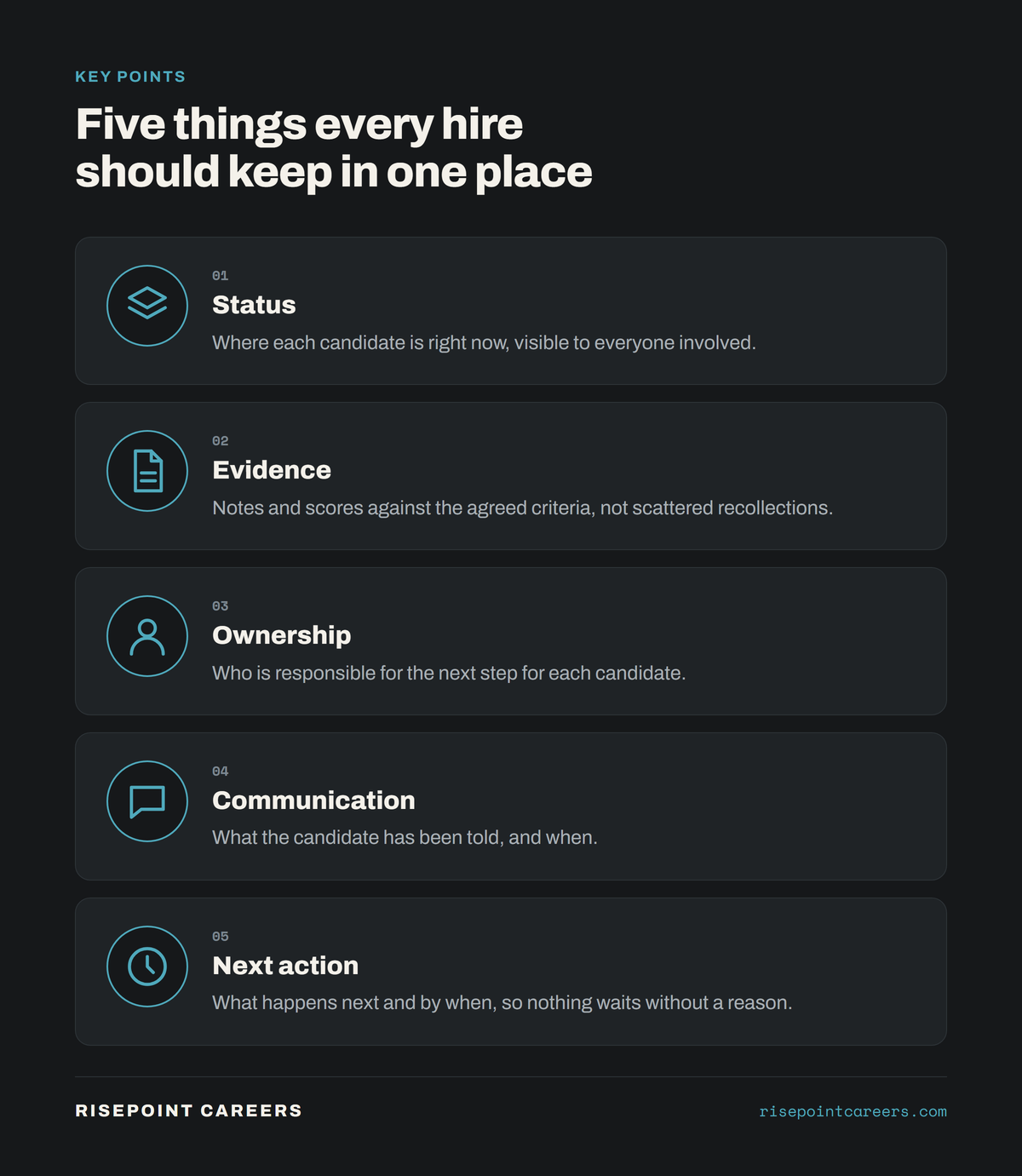
The fix is not more tools. It is one place where every hire is visible from start to finish, holding five things.
1. Status. Where each candidate is right now. Anyone involved should be able to answer "where is this person in the process?" in seconds, without asking around.
2. Evidence. Notes and scores recorded against the criteria the team agreed before the first application arrived. The US Office of Personnel Management describes structured interviews as evaluating every response using the same rating scale and standards. Those ratings are only useful if they end up somewhere the whole team can compare them.
3. Ownership. One named person for the next step of each candidate. Not "the team." A person.
4. Communication. What the candidate has been told and when. This is the line that stops a strong applicant from waiting a week without hearing anything.
5. Next action. What happens next and by when. A candidate with no next action is a candidate the process has quietly forgotten.
A quick before and after
Here is the same week of hiring run two ways.
Before: twelve applications arrive by email and through a job board. The manager flags three in chat. Two interviews are booked from personal calendars. The third candidate is never contacted because everyone thought someone else had done it. At the end of the week the team cannot say who is waiting on what.
After: all twelve applications land in one place. The manager marks three to interview, each with an owner and a date. Interview notes are scored against the same four criteria in the same record. On Friday, anyone on the team can see that one candidate is waiting for a reply, and who needs to send it.
The second version is not more work. Most of the work already existed. It simply stops being hidden.
Start with a simple audit
Before changing anything, trace one recent hire from start to finish. Write down every tool and every person the process touched, and every place a decision or note was recorded. Most teams are surprised by the length of the list.
Then ask one question at each handoff: if this person were away tomorrow, could someone else see what happens next? Wherever the answer is no, you have found a gap.
The bottom line
Fragmented hiring does not fail loudly. It fails through delays nobody notices, decisions nobody can explain, and candidates who stop waiting. Bringing status, evidence, ownership, communication and next actions into one visible sequence turns that hidden work into something a team can see, share and improve.
If you are weighing whether you need software for this, we covered what a small team actually needs from an applicant tracking system in an earlier article. The audit above will tell you most of what you need to know.