
Ask a hiring manager to describe the person they want, and the answer is often very precise.
A senior operations manager, from a logistics company of about our size, with eight years of experience, a business degree, fluent in our planning software, a self starter, ideally someone who has come up through the warehouse.
That description is clear. The trouble is that it is clear about one person. Often it is a picture of the last person in the role, or of the manager themselves at an earlier stage of their career.
In our last two articles we broke the role into observable work and separated requirements from preferences. This article is about what happens when that clarity goes too far.
How a brief turns into a portrait
Over definition rarely happens on purpose. It builds up.
Old descriptions get reused. In the Hidden Workers study by Harvard Business School and Accenture, 72 percent of employers said they recycled existing job descriptions for middle skills roles, and 38 percent said they used existing or slightly altered ones for high skills roles. Joseph Fuller, who co chairs the school's Project on Managing the Future of Work, summarised the findings in an article for Working Knowledge.
Each reuse can add another line. Fuller describes companies filtering out all but those candidates who match "exacting and expanding requirements". The people screened out include those whose years of experience do not precisely match, those with gaps on their resumes, and those without a degree.
The result is a list that is very precise, and very narrow.
What a narrow profile costs
A narrow profile shrinks the pool before anyone has looked at a single application.
The University of Essex makes the trade off clear in its guide to writing a person specification. If criteria are too narrow, there is a danger of only a few applicants. If they are too broad, you attract many who are not suitable, and shortlisting becomes slow. The aim is the useful middle.
The Hidden Workers survey suggests that the narrow end has a real cost. Firms in the survey that hired from untapped talent pools were 36 percent less likely to report shortages of talent and skills than firms that did not. That figure comes from what the employers themselves reported, so treat it as a strong signal rather than a precise forecast.
The role will change anyway
There is a second problem with a very detailed portrait. It assumes you know exactly what the job will need.
In a growing company, that is rarely true. Customers change, products change, and priorities change. The planning software you name in the ad may be replaced in two years. The manager who would have been perfect for today's role may struggle with next year's.
The person who handles that change well might not look like the portrait at all. They might be a career changer, or someone from an adjacent industry who has already lived through a similar shift.
Fix the work, leave the route open
The solution is not to stop defining the role. It is to be precise about the right things.
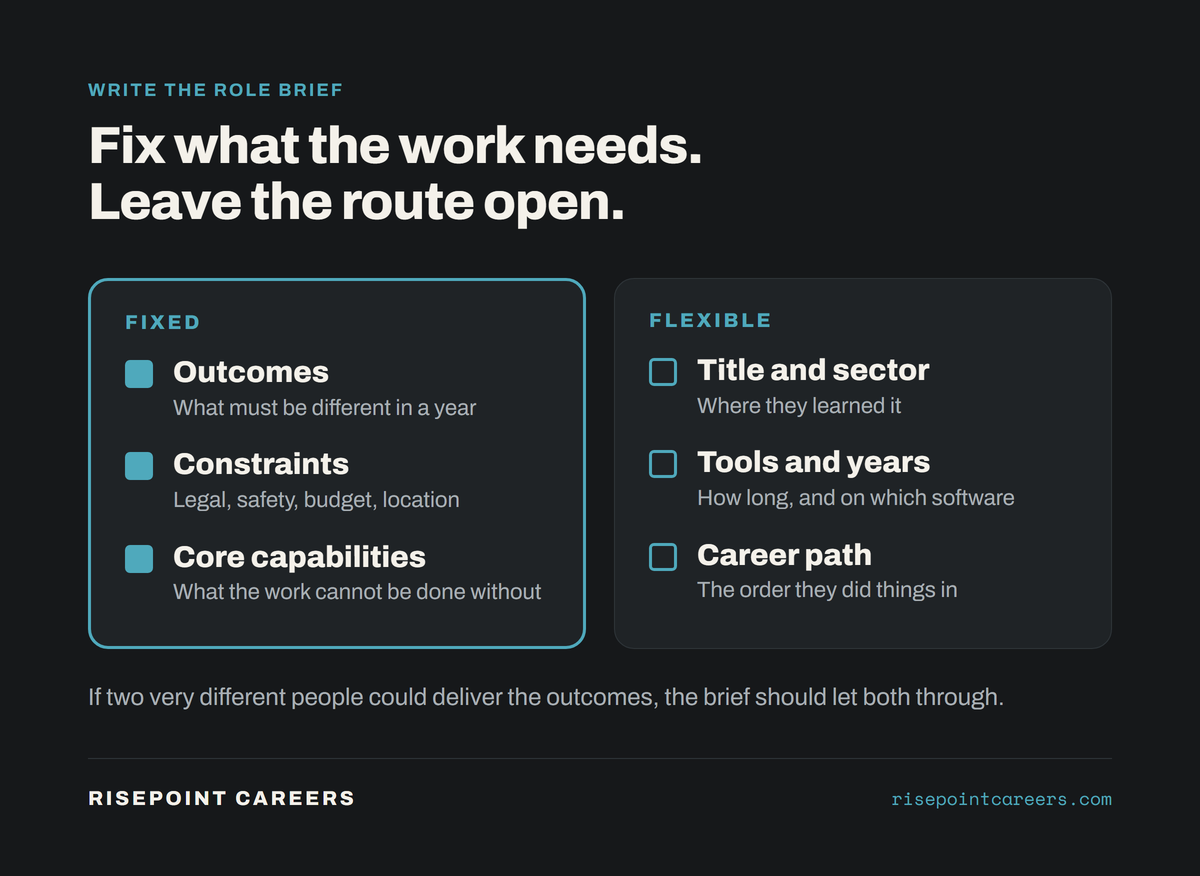
Be firm about the outcomes the role must deliver, the constraints it works within, and the capabilities the work genuinely depends on. Be open about the route: the title someone held, the sector they worked in, the tools they learned on, how many years it took them and the order they did things in.
The UK Civil Service uses a similar idea in its Success Profiles framework. It looks at five elements, behaviours, strengths, ability, experience and technical skills, and says that not all of them are relevant to every role. In other words, experience is one element among several, not the whole picture.
Rewrite the portrait
Go back to the operations manager from the start of this article and sort each part of that description.
Outcomes: reduce late deliveries, bring the planning process under one system, and build a team that can run day to day operations without the founder.
Constraints: must be based near the warehouse; must be able to work within the current budget for the team.
Core capabilities: running a planning cycle, managing a small team through change, and working with data to spot problems early.
Everything else is open. Logistics experience may help, but someone who has run operations in manufacturing or retail may handle the same outcomes. Eight years and a business degree describe a route, not a result. The planning software can be taught. "Came up through the warehouse" describes the manager's own story, not the job.
The brief is still clear. It is now clear about the work.
Try the two people test
Here is a quick check for any role brief.
Picture two quite different people who could both deliver the outcomes. One has done this exact job in your industry. The other has run a similar operation somewhere else, or has built the same skills by a different route.
Now read your brief. Does it let both of them through? If one is screened out by a line about sector, title or years, ask whether that line protects the work or just describes the familiar candidate.
The Hidden Workers authors make a related suggestion about screening. Many applicant tracking systems use negative filters, such as excluding candidates without degrees or with a gap in employment. They suggest affirmative filters instead, which look for the essential skills and experiences known to go with success in the role.
The bottom line
A clear role should reduce confusion. It should not turn one manager's mental picture into a barrier. Define the outcomes, the constraints and the capabilities that matter enough to guide a fair decision. Then leave room for more than one credible route to get there.