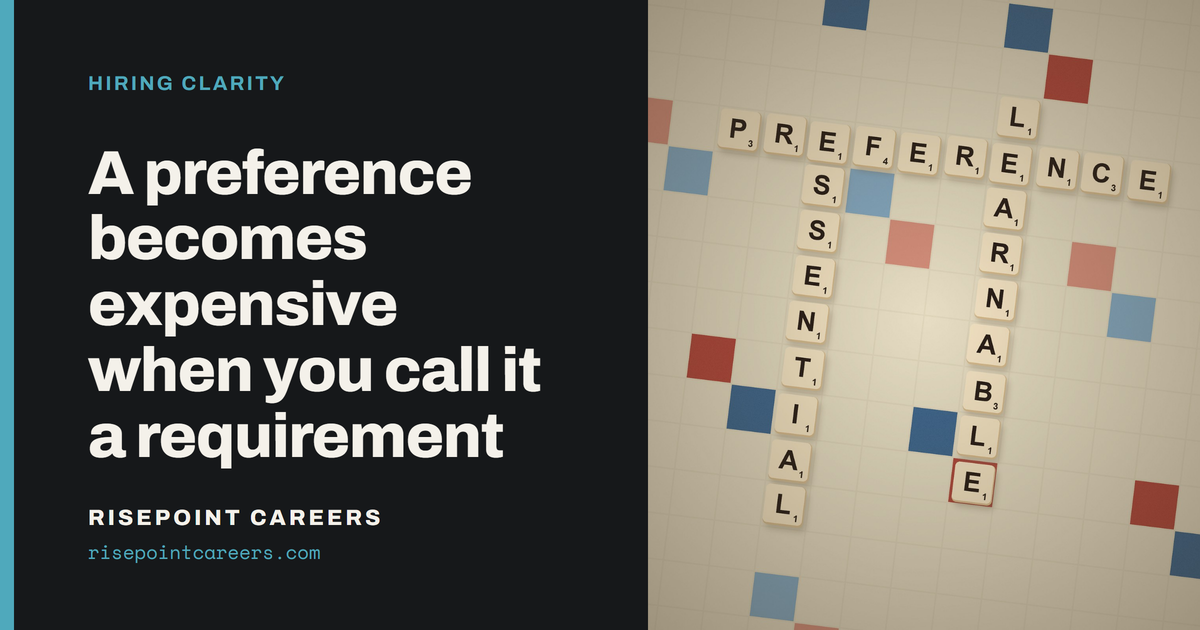
A small firm is hiring an office manager. The draft ad asks for a business degree, five years of experience, a background in construction and knowledge of one particular accounting package.
Each item feels sensible. A construction background might shorten the learning curve. The degree is familiar. Five years sounds safer than three. But ask whether the work truly depends on any of them, and the list starts to look different.
In our last article we split a role into the work you can actually observe. That work is where requirements should come from. Anything else is a preference, and it should be labelled as one.
Every requirement changes who applies
A requirement is not a neutral line on a page. It decides who reads the ad and thinks "this is for me", and who is screened out before anyone looks at their experience.
The University of Essex puts it directly in its guide to writing a person specification. A qualification that is not necessary, or too high for the level of the post, should not be included, because it could deter good applicants and reduce the pool available.
The Ontario Human Rights Commission goes further in its guidance on setting job requirements. It says inflated requirements pose discriminatory barriers for racialized applicants and others, such as people with disabilities. Its example is a familiar one: requiring a university degree when a high school diploma would do.
So when a preference is written as a requirement, the company pays for that comfort with a narrower pool. It may never meet the people who could have done the work well.
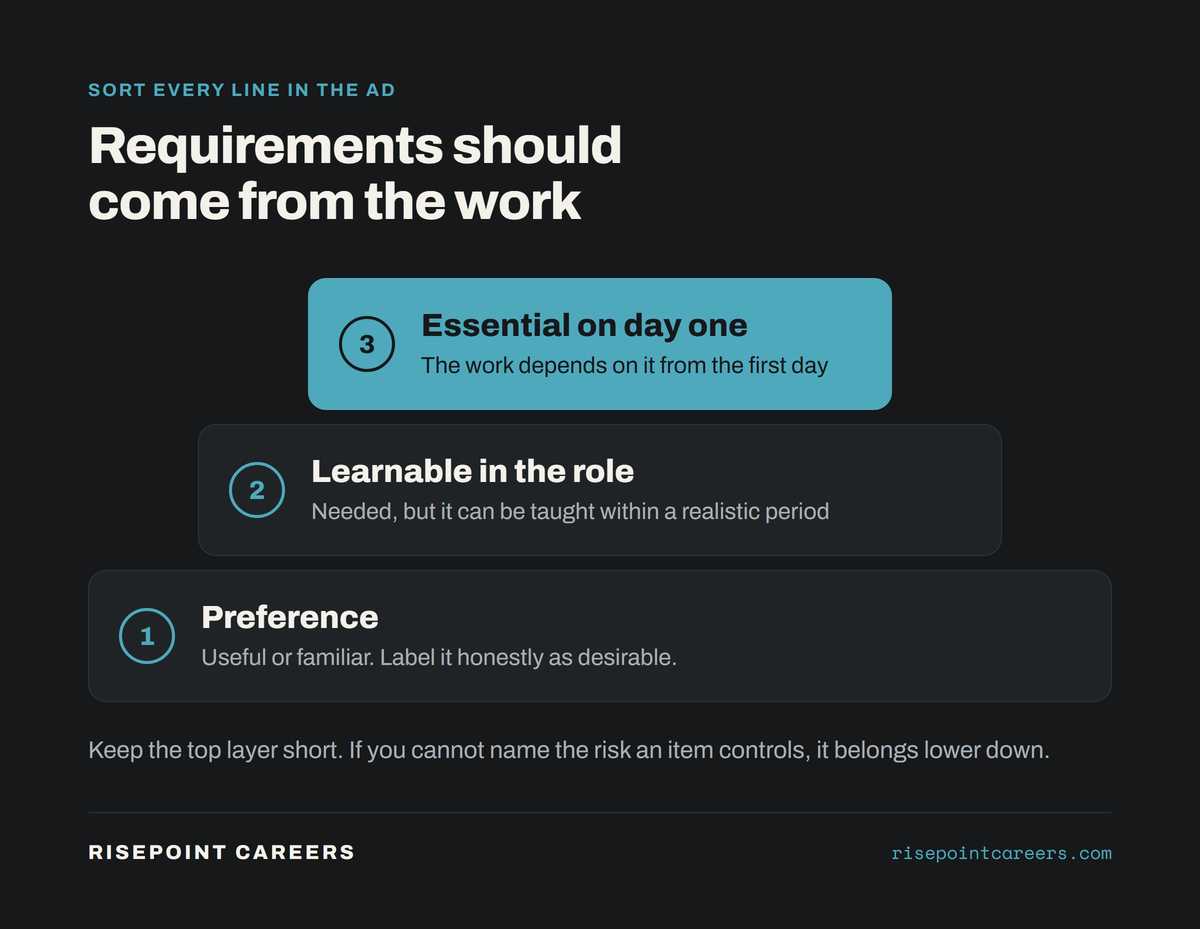
Essential, learnable or preferred
Many employers already sort criteria into two lists, essential and desirable. Essex defines them clearly.
Essential criteria are the minimum you will accept when the person starts work. Essex tells hiring managers not to include any criteria that are not essential from day one.
Desirable criteria cover two different things: skills that would be useful but are not needed to do the job, and skills that are needed but not from day one, because the person could pick them up after they are appointed, for example through training. Essex asks managers to make clear which of the two applies.
That second group is worth separating out. A specific accounting package is a good example. If someone already knows a similar tool, they may be able to learn yours in a few weeks. That makes it learnable, not essential.
Four questions for every requirement
Before an item goes into the ad as a requirement, put it through four questions.
1. What risk does this control? Name the specific thing that would go wrong without it. "They might struggle" is not specific enough. "They would be signing off payroll without understanding the rules" is.
2. Could the capability be shown another way? A degree is often a stand in for something else, such as writing ability or analytical skill. Essex suggests asking whether knowledge gained through equivalent experience would be enough, and gives a broad example: educated to degree level, or holding an equivalent qualification, or equivalent relevant experience.
3. Can it be learned within a realistic period? If a capable person could pick it up in the first few months, it belongs in the learnable group, not the essential one.
4. Is there a legal, safety or operational reason it must exist on day one? Some requirements pass easily. A driver needs a licence. A role that handles regulated work may need a specific certification. Those are real requirements, and they should stay.
If an item does not survive these questions, move it to the desirable list or remove it.
Watch the familiar ones
Some requirements appear in ads so often that nobody questions them.
Years of experience. Five years is a number, not a capability. Essex does not specify a number of years of experience at all, noting that it could lead to claims of age discrimination, and focuses instead on the skills the job actually requires. Ask what someone with five years can do that someone with three cannot, and write that down instead.
Local or industry experience. The Ontario commission notes that a requirement for Canadian experience may limit applications from recent immigrants, and says all prior experience should be assessed, regardless of where it was obtained. The same thinking applies to industry background. Someone who has run an office in logistics may do well in construction.
Degrees. We wrote about inherited requirements before. A degree is worth requiring when the work depends on the knowledge it represents. If it is there because the last ad had it, test it.
Requirements should be defensible
This is not only about the size of the pool. Requirements can be challenged.
The Ontario commission sets out a three step test for whether a requirement is reasonable and genuine. It must have been adopted for a purpose rationally connected to performing the job, adopted in good faith, and be reasonably necessary to accomplish that purpose. In the United States, the Equal Employment Opportunity Commission says that when a selection procedure disproportionately excludes a protected group, the employer must show it is job related and consistent with business necessity.
This article is not legal advice. But the practical lesson is the same in both places. If you can explain how each requirement connects to the work, you are in a far stronger position than if you cannot.
What the rewrite looks like
Back to the office manager. After the four questions, the ad might read:
Essential: experience running payroll and supplier invoicing for a small team; confidence keeping accurate financial records.
Learnable: our accounting package, which we will train you on.
Desirable: experience in construction or a related trade.
The degree and the five years are gone. Nothing the work depends on has been lost, and the ad now speaks to people who can do the job, wherever they learned it.
The bottom line
Requirements should come from the work. For each one, name the risk it controls, ask whether it could be shown another way or learned in the role, and check whether the work truly needs it on day one. Whatever is left is a preference. Label it honestly, and you will see more of the people who could actually do the job.