Ask a founder or team lead at a growing company why they do not have a formal hiring process, and you will often hear the same answer: they do not want bureaucracy. They have seen long forms, interview committees and approval chains at larger employers, and they want none of it.
That instinct is reasonable. But it rests on a false choice. The alternative to bureaucracy is not having no structure at all. It is having the right amount.
In our last article we suggested drawing your hiring process before adding software. Once you have the map, the next question is how much structure to add. This article is about where to draw that line.
What bureaucracy actually is
Bureaucracy is not the same as having steps. It is steps that do not improve the decision.
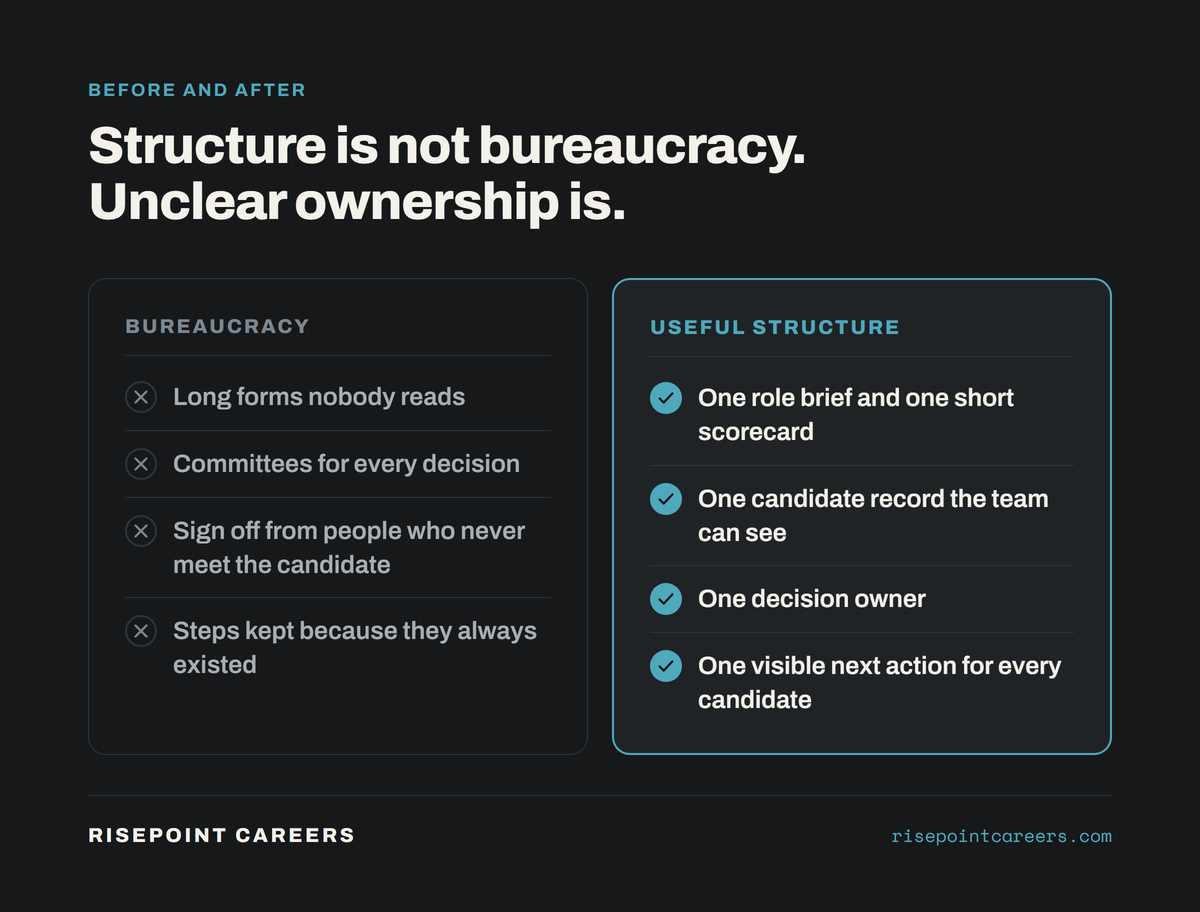
A form nobody reads is bureaucracy. A sign off from someone who never meets the candidate is bureaucracy. A third interview round, added because the first two were not structured enough to compare, is bureaucracy. Each adds time without adding clarity.
Useful structure is different. It makes a decision clearer, faster to coordinate and easier to explain later. The test for any step is simple: does it help someone decide better, or does it only make the process longer?
What happens without structure
Small teams that avoid structure do not end up with no process. They end up with an invisible one. Decisions depend on memory, private notes and whichever manager happens to be free that week.
That works while hiring is rare. It breaks down when the company is hiring for several roles at once, when more than one person interviews, or when a candidate asks why they were turned down. At that point nobody can explain the decision, because it was never written down in one place. We looked at the cost of that in Hiring breaks when the process lives in five different places.
The lightweight version
A lightweight hiring process for a small team fits into five pieces.
1. One role brief. A short page saying why the role exists, what the person will do in the first six months, and what is essential versus what would be nice to have. NCVO, which supports charities in England, advises employers in its guidance on designing a role to state clearly which criteria applicants must have and which could be acquired after appointment, and to ask for qualifications only if they are necessary for the job.
2. One short scorecard. Three to five criteria taken from the brief, scored the same way for every candidate. The UK government's Companies House blog, in its step by step guide to hiring employees, advises scoring each candidate's answers to core questions and making brief notes, so applicants can be sifted fairly.
3. One candidate record. Every application, note and score in one place the whole team can see. Not three inboxes and a chat thread.
4. One decision owner. One named person who makes the final call after hearing from the others. Group input is useful. Group ownership usually means nobody owns it.
5. One visible next action. For every candidate, a clear next step and the name of the person doing it. This is what stops candidates waiting a week to hear anything.
That is the whole structure. It fits on a page and can run in a spreadsheet or a dedicated system.
Make the process no heavier than the risk
A useful rule: a process should be no heavier than the risk it manages.
Hiring a contractor for a two week project carries little risk. A role brief and a short conversation may be enough. Hiring your first finance lead, someone who will handle money and sensitive data, carries much more. That justifies a more careful scorecard, more than one interviewer and reference checks.
The Companies House guide makes the same kind of judgement. It says that ideally at least two people should be involved in sifting applications, but it also tells small businesses not to panic if that is not possible. The goal is fairness and consistency, not a fixed number of steps.
Some risks are the same at any size. Acas, the UK body that advises employers, states in its guidance on hiring someone that employers must not discriminate when advertising, interviewing and deciding who to employ. In the United States, the Equal Employment Opportunity Commission's recordkeeping requirements say employers must keep all personnel or employment records for one year. A small company still needs to be able to show how a decision was made. A scorecard and a single candidate record make that easy. Memory does not.
Signs your process is too heavy, or too light
Too heavy:
- candidates are asked for information you already have;
- decisions wait on people who add no new evidence;
- interview rounds keep being added because earlier ones did not produce comparable notes.
Too light:
- two interviewers give feedback that cannot be compared;
- nobody can say who made the final decision;
- candidates have to chase you for updates.
Seeing signs from both lists at once is common. It usually means effort is going into the wrong steps, not that there is too much or too little effort overall.
The bottom line
Structure is not bureaucracy. Unclear ownership is. A small team does not need committees and long forms, but it does need one role brief, one scorecard, one candidate record, one decision owner and one visible next action. Keep each step only if it makes the decision clearer, and keep the whole process no heavier than the risk it manages.