
Most teams treat the job description as marketing. Something to get right enough, publish and move on from.
It is also the first part of your selection system. Before anyone has applied, it has already started deciding who will.
Every line sends a signal. A vague responsibility makes the role harder to understand. An inherited qualification narrows the pool. A long list of tools can lead capable people to rule themselves out before you have seen any of their evidence.
Who relies on the job description
Think about how many people and systems use this one document after it is written.
Candidates use it to decide whether to apply. They cannot ask what you meant. They read the words and decide.
Recruiters use it to search. If the description says "SaaS experience required", they filter for SaaS, whether or not it really matters.
Screening tools compare applications against it. They do what the document says, consistently and at scale.
Interviewers use it to prepare. Most assume it reflects the real priorities of the role, and build their questions around it.
The hiring panel uses it to decide. When there is a disagreement, the job description is usually what people point to.
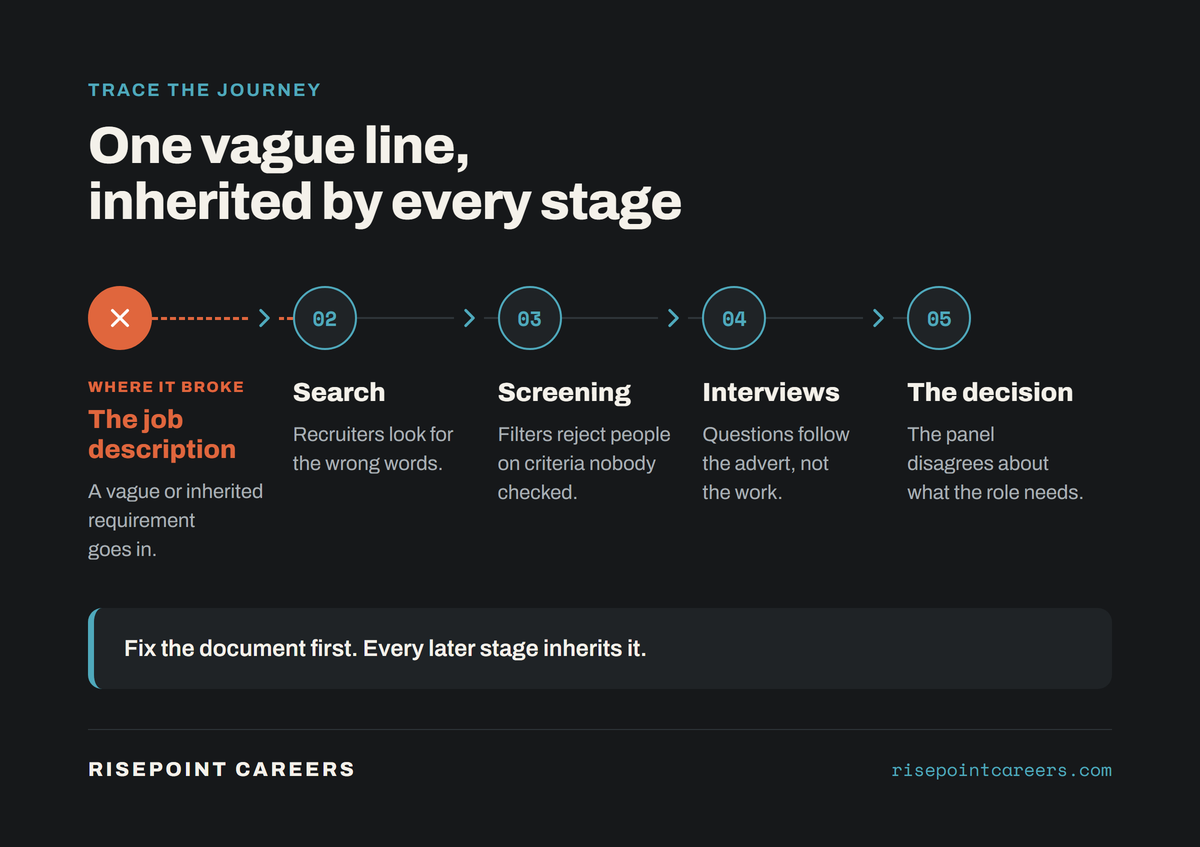
That means an unclear line is not harmless. It becomes poor input for every stage that follows.
The cost of inherited requirements
Many job descriptions are not written. They are inherited. Last year's version is copied, a few new tools are added, and nothing is taken out.
Research by Harvard Business School and Accenture found exactly this pattern. Their report notes that most companies add new skills and experience preferences to existing job descriptions rather than re-evaluating them from scratch. The result is a profile loaded with legacy requirements and nice to have attributes, instead of a short list of must haves linked to performance.
The same research found that 88 percent of employers agreed qualified high skills candidates are vetted out because they do not match the exact criteria in the job description. For middle skills roles, the figure was 94 percent. Employers are not unaware of the problem. They are often running a process built on a document nobody has rechecked.
We looked at one version of this in preferences written as requirements: a nice to have that quietly becomes a filter.
Selection should rest on the work
Good practice in selection has always started from the job itself. The US Office of Personnel Management calls job analysis the foundation of all assessment and selection decisions: understanding the tasks, the competencies they require, and the link between the two.
US federal guidelines on employee selection go further. Where an employer relies on a test or procedure being representative of the job, the guidelines expect a job analysis of the important work behaviors and their relative importance. They also note that this approach does not suit skills employees are expected to learn on the job.
You do not need a formal validation study to use that principle. The point is simple: what you screen for should be traceable to the work the role actually requires. A job description that does not describe the work cannot support a fair or consistent selection process.
What a useful job description does
A job description that works as part of a selection system covers four things clearly.
The work. What the person will do most weeks, in plain language. Not "drive operational excellence" but "run the weekly stock count across three sites and fix discrepancies before month end".
The outcomes. What should be different after six or twelve months. This tells candidates what success looks like, and tells interviewers what to probe for.
The genuine constraints. Licences, legal requirements, working hours, travel, location. The things that truly cannot flex, stated plainly.
The basis of evaluation. Which capabilities you will assess, and roughly how. This helps suitable candidates recognize themselves, and it keeps the panel consistent after applications arrive.
If you have already built a role skills map, most of this is written. The job description becomes a readable version of it.
A short example
A distribution company needs a shift supervisor. The job description, copied from three years ago, asks for a degree in logistics, five years of supervisory experience, experience with a named warehouse system and "excellent leadership skills".
Applications are thin. The recruiter filters on the degree. Interviewers ask about leadership in general terms. Two finalists are hard to compare because nobody agreed what mattered most.
The hiring manager rewrites it from the work. The role runs a night shift of 25 people, keeps picking accuracy above target and handles safety incidents. The degree moves to preferred. The warehouse system becomes something the company will train. The description now says which capabilities will be assessed: shift planning, coaching under pressure and incident handling.
The next round brings in two former retail store managers and a team lead from a food factory. The panel now has a shared basis for comparing them, and each interviewer knows which part of the role they are testing.
Nothing about the job changed. Only the document that described it.
The bottom line
A job description is not just an advert. It is the first input to search, screening, interviews and the final decision. Every vague or inherited line flows through all of them. Write it from the work, separate real constraints from preferences, and say how candidates will be evaluated. A clearer document leads to a fairer and more consistent process.