Ask a hiring team to list the skills a role needs and you will often get fifty of them within ten minutes.
Communication. Attention to detail. Excel. Stakeholder management. Resilience. Problem solving. The list grows until it describes almost any job, and it helps with almost none of the decisions you need to make.
In earlier articles we suggested you start with one role family and explained that not everything in a job description is a skill. This article is the practical step that follows: build a skills map for one role, keep it to ten capabilities, and make each one specific enough to use.
Pick one role that matters
Choose a role you hire for regularly, or one you keep struggling to fill. A role you hire often gives you plenty of chances to test the map. A role that is hard to fill is where a better description pays off fastest.
Do not start with the whole department. One role, done properly, will teach you more than ten done quickly.
Start from the work, not the job description
The existing job description is tempting as a starting point. Resist it. It usually mixes tasks, tools, credentials and personality traits, and copying it moves the confusion into your skills map.
Start instead from what the person actually does: the recurring work, the decisions they make, the projects they deliver and the people who depend on them. We described how to break a role into observable work in an earlier article.
This is the standard approach in public sector hiring too. The US Office of Personnel Management calls job analysis the foundation for all assessment and selection decisions, and describes it as looking at the tasks performed, the competencies needed for them, and the connection between the two. The capability follows from the work, not the other way round.
Choose ten, not fifty
From that work, pick the ten capabilities that most directly affect success. Not every capability someone uses. The ones that separate a strong performer from a struggling one.
Ten is a deliberate limit. It forces the team to argue about what really matters, and it produces a map short enough that hiring managers will actually read it. If you cannot get below twenty, you are probably listing tools and traits alongside capabilities, or describing several roles at once.
Add four notes to each capability
A name on its own is not enough. "Stakeholder management" means something different for a junior coordinator and for a head of operations. For each of the ten, add four short notes.
What it looks like here. Describe the capability in the context of this role. "Keeps three regional managers informed about delays before they hear about them from customers" is far more useful than "stakeholder management".
What level is needed on day one. Separate what the person must bring from what they can grow into. Frameworks such as SFIA describe seven levels of responsibility, from following instructions up to setting strategy. You do not need a formal scale, but you do need to say whether you expect someone to do this alone from the start or with support for the first few months.
What evidence would support the claim. Decide in advance what would convince you. A work sample, a specific example in interview, a portfolio, a reference from a manager. This turns the map into an assessment plan.
What other people call it. Candidates, recruiters and other industries use different words for the same capability. The European Union's ESCO classification gives each skill concept one preferred term and a number of non preferred terms in each of its 28 languages, because the same idea really is described in many ways. Your map should do the same on a small scale. "Client escalation handling" may appear on a resume as "complaint resolution" or "account recovery".
Classify each capability
Finally, give each capability one of five types: foundational, behavioural, functional, technical or domain specific.
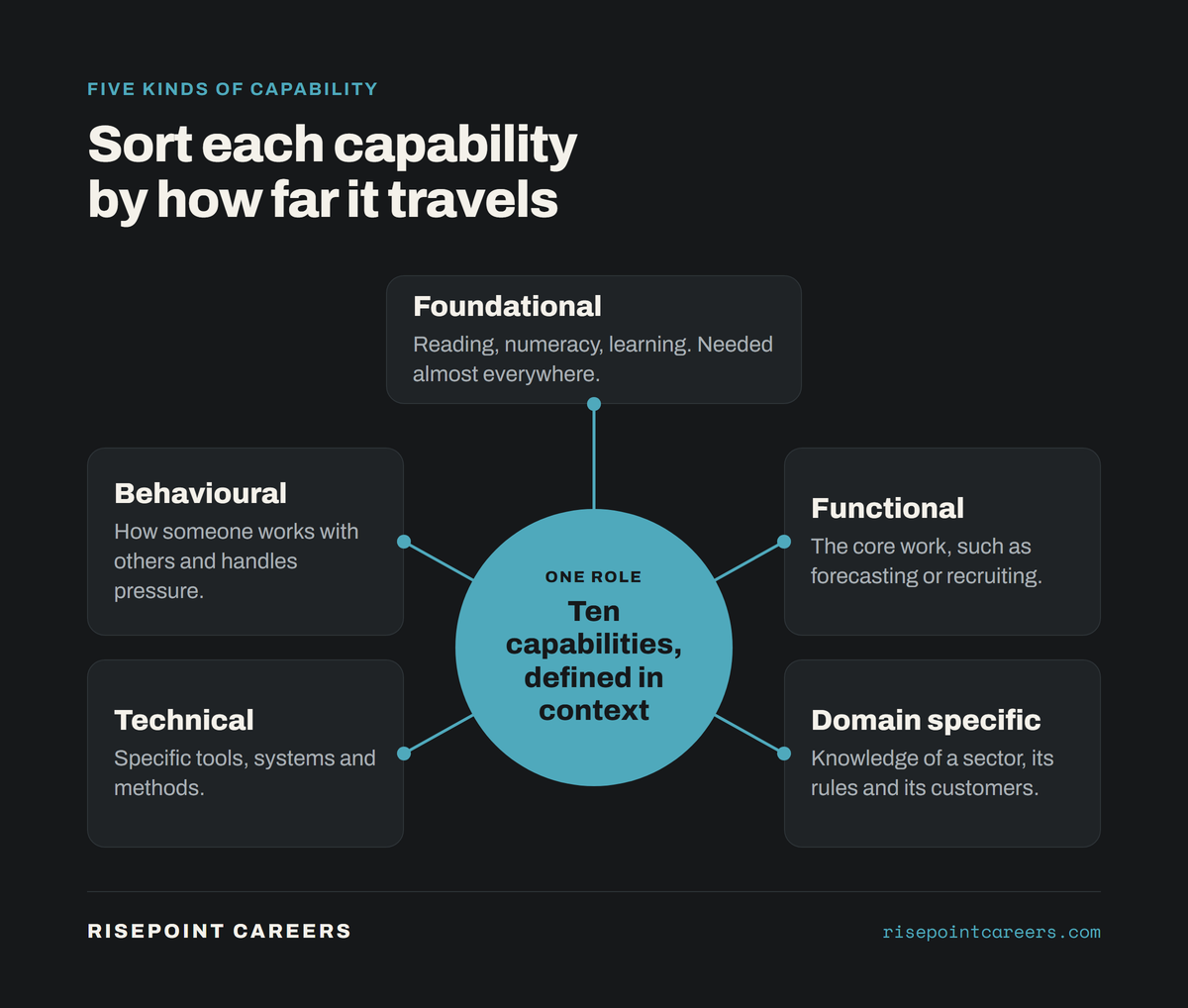
The point of this step is to see which capabilities travel. O*NET, the US occupational database, separates transferable skills, which you can use across different jobs, from knowledge and more specialised skills. ESCO likewise tags each skill with a reusability level, from transversal to sector specific and occupation specific.
When your map shows that seven of ten capabilities are foundational, behavioural or functional, you know that strong candidates may come from other sectors. When most are domain specific, you know that experience in the industry matters more, and that training a career changer will take longer.
A short example
A software company wants to hire a customer support team lead. The old job description lists 23 requirements, including "SaaS background", "Zendesk expert" and "passionate about customers".
The hiring manager and two current team leads spend an hour on the work instead. They agree on ten capabilities. One of them reads:
- Capability: handling escalated complaints
- What it looks like here: takes over calls that agents cannot resolve, calms the customer and agrees a fix within one working day
- Day one level: handles escalations alone; coaching others on them can come later
- Evidence: a walk through of a difficult case they resolved, with what they said and why
- Other terms: complaint resolution, escalation management, account recovery
When they classify all ten, only two are domain specific: knowledge of the product and of software billing. "Zendesk expert" turns out to be a technical skill any capable lead could learn in a few weeks. The team decides to look at candidates from hospitality and retail banking, where escalation handling is a daily part of the job.
Use it once, then improve it
Do not wait until the map feels finished. Use it on the next live hire for this role: write the interview questions from it, score candidates against it, and note where the panel disagreed or found a capability hard to judge.
Then revise. Drop what did not help a decision, sharpen what caused confusion, and add the term a strong candidate used that nobody had listed. A map that has been through one real hire is worth more than one perfected in a workshop.
As we noted in what makes a skill record useful, context, level, recency and evidence are what turn a skill name into something you can act on. A role skills map applies the same idea to the job itself.
The bottom line
Pick one role. Start from the work. Choose the ten capabilities that matter most, and for each one write what it looks like here, the day one level, the evidence you would accept and the other names it goes by. Classify them so you can see which ones travel. Then test the map on a real hire and improve it from what you learn.