Look at almost any skills list, on a profile, a resume or an internal system, and you will see words like "leadership", "analysis" and "communication".
Each may be true. But each can describe a two day course, a small project or ten years of high stakes work. The word alone does not tell a hiring manager which.
In our last article we argued that skills give the workforce a shared language. This one is about what each entry in that language needs to hold. A list of names looks structured. It often carries very little information.
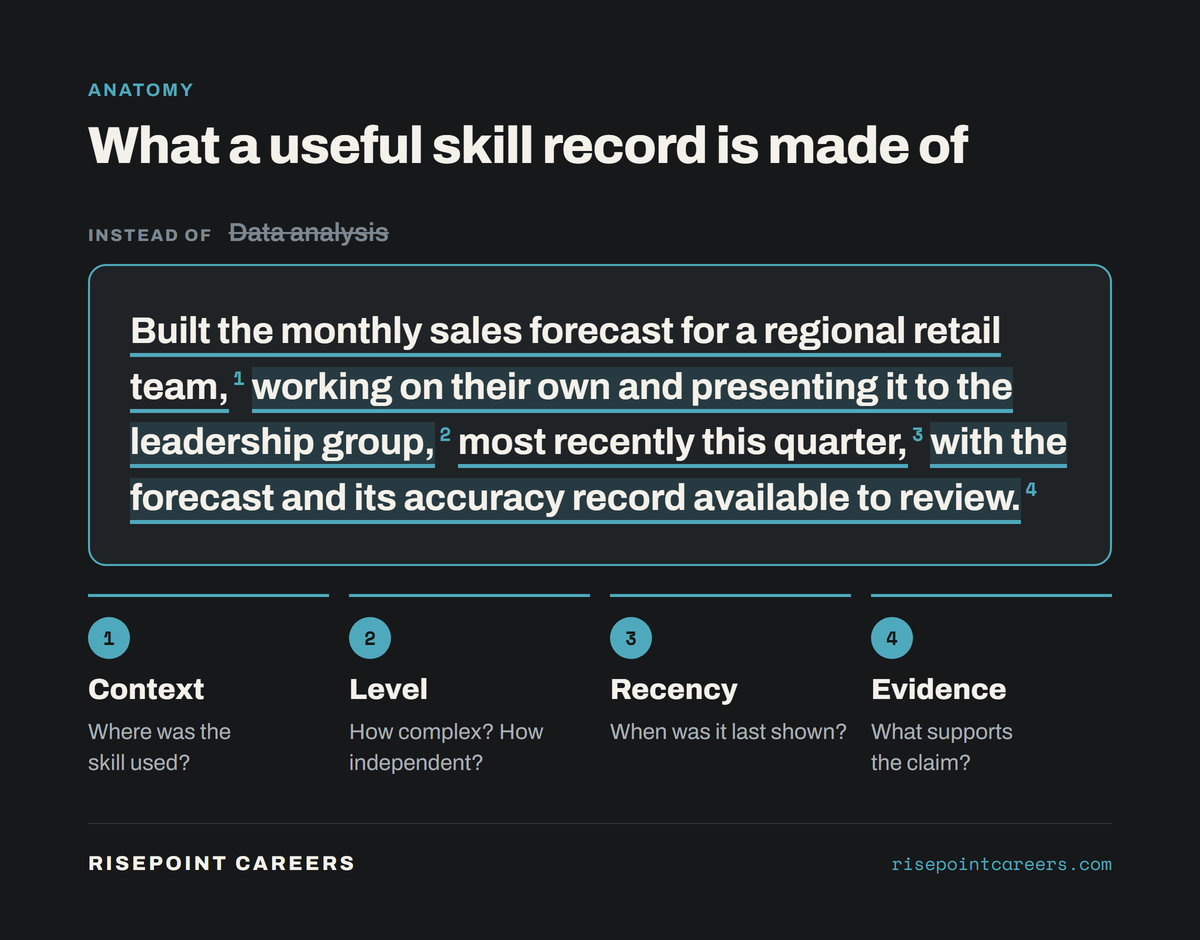
Four things a useful skill record holds
1. Context
Where was the skill used? For what kind of work, at what scale, with whom?
"Data analysis" in a monthly sales forecast for a retail team is different from data analysis in a clinical trial. Both are real. They are not interchangeable.
2. Level
How complex was the work, and how independently was it done?
Public frameworks treat this as separate from the skill itself. O*NET, the US occupational database, rates every skill on two different scales: importance and level. Importance says how central a skill is to a job. Level says how much of it the job needs. Its own example: speaking is important to both lawyers and paralegals, but lawyers need it at a higher level.
The SFIA framework, used for digital and technology roles, goes further. It describes seven levels of responsibility, from performing routine tasks under close supervision up to setting strategy for a whole organization. The same skill at level 3 and level 6 describes very different people.
You do not need seven levels. Three is often enough for a small team: can do it with guidance, can do it independently, can lead it or teach it.
3. Recency
When was the skill last used?
Some skills hold steady for years. Others fade or go out of date quickly, especially tools and technical methods. A record that says "last used three months ago" and one that says "last used in 2019" should not be read the same way.
4. Evidence
What supports the claim? An output, a result, an assessment or an example someone could check.
Evidence can be formal. The European Union's European Digital Credentials for Learning are signed digital records of learning outcomes and assessments, which anyone can verify against the issuer. But most evidence in hiring is less formal: a work sample, a portfolio, a described result or a reference. What matters is that it exists and that someone could look at it.
Then ask: does it matter for this decision?
Relevance is not part of the skill record itself. It depends on the role you are filling.
A capability can be strong, recent and well evidenced and still be peripheral to the job in front of you. This is where O*NET's split between importance and level is useful in practice. For each role, decide which skills are central and at what level, then compare the records against that. We covered how to work this out in break the role into observable work.
Four kinds of skill, not one
Put together, these fields let an organization tell apart four things that a plain list treats as identical:
- A claimed skill: a name, with nothing behind it yet.
- An evidenced skill: a name with something someone could check.
- A current skill: evidenced and used recently.
- A skill that matters here: current, at the right level, and central to this role.
Each is useful. A claimed skill is a reason to ask a question in an interview. A skill that matters here is a reason to move someone forward. The mistake is treating them as the same thing.
A short example
Two internal candidates both list "project management".
The first ran a three month office move for a team of 20, coordinating suppliers and a fixed budget, last year. Their manager can describe the result.
The second completed an online project management course in 2021 and has not led a project since.
On a plain list, both say "project management". With context, level, recency and evidence attached, the difference is obvious, and so is the right interview question for each.
Five questions that fill in the record
You do not need a form or a new system to collect this. In an interview, a career conversation or a self review, five questions are enough:
- Where did you use this skill, and on what kind of work? This gives you context.
- How much of it did you do on your own, and how complex was it? This gives you level.
- When did you last use it? This gives you recency.
- What could I look at that shows it? This gives you evidence.
- How would you use it in this role? This starts the conversation about relevance.
The answers are often more revealing than the skill name. Someone who answers the first question with a specific, recent example usually has the skill. Someone who struggles may still have potential, but you now know where to probe.
Keep the record simple
None of this needs a complex system. A shared spreadsheet with five columns works: skill, context, level, last used and evidence. The aim is not to describe everything. It is to hold just enough to support a better decision.
Start with the skills that matter most for your next few hires. Ask candidates and employees for the context and evidence, not just the name. Review the records when someone changes role.
The bottom line
A skill name on its own is a claim. Context, level, recency and evidence turn it into information you can use. Then judge relevance against the role in front of you. That is the difference between a skills list that looks organized and one that actually helps you decide.