Ask three companies what a "customer success manager" does and you may get three different answers. One means onboarding new clients. One means renewals and upselling. One means a senior support role.
The reverse is just as common. The same work can be called customer success, account management, client service or relationship management. One company's project coordinator does what another calls a program analyst.
Inside a single organization, titles work well enough. People know what their colleagues do. The trouble starts when hiring, learning and workforce planning all depend on titles alone.
What goes wrong when titles are the only language
Hiring narrows too early. If you search for people who held the same title, you miss people who did the same work under a different name. We looked at this in preferences written as requirements and in do not shrink the search to one person.
Internal moves get missed. Someone in your support team may already have most of what an operations role needs. If the only data you hold is their title, nobody will notice.
Learning drifts. Training gets bought by department or by title, not by the specific gap it is meant to close. It is hard to tell whether a course helped, because nobody wrote down what it was for.
Planning stays vague. "We need more analysts" is a title. "We need four more people who can build and explain a forecast" is a capability you can plan for.
Skills as a layer beneath the titles
A shared skills language does not replace job titles. It sits underneath them.
It lets you connect three things that are usually kept apart:
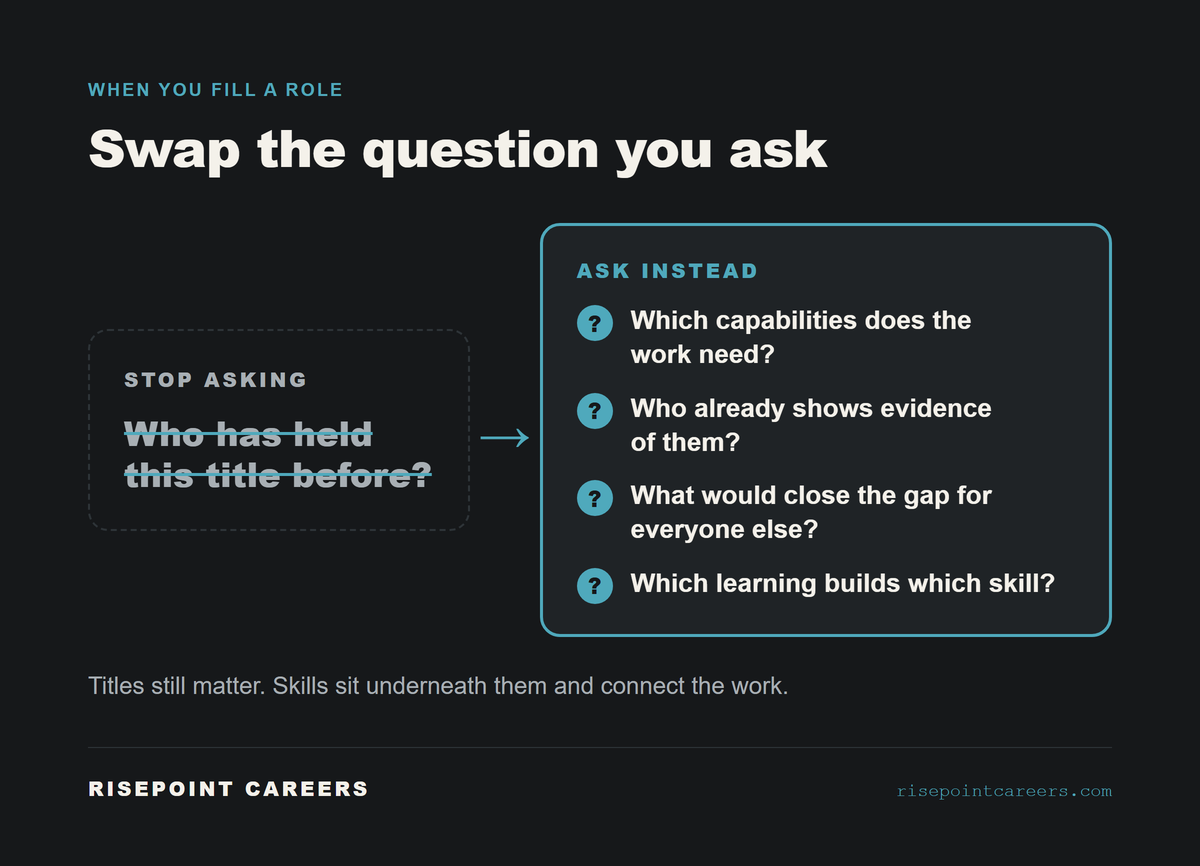
- A role to the capabilities it needs.
- A person to evidence of those capabilities.
- A learning activity to the specific gap it closes.
Once those links exist, the same definitions work for a job ad, an interview scorecard, an internal move and a training plan.
You do not have to invent it from scratch
Large public frameworks already exist, and they show how this works at scale.
The European Commission's ESCO classification describes 3,039 occupations and 13,939 skills, linked to each other and translated into 28 languages. It calls itself a common language for occupations and skills, and online platforms use it to match job seekers to jobs based on skills.
In the United States, O*NET describes more than 900 occupations through the same set of building blocks: knowledge, skills, abilities, work activities and tasks.
For technology and digital work, the SFIA framework describes itself as a common language for skills and competencies in the digital world. It sets skills against seven levels of responsibility, and organizations use it to write role profiles, set recruitment criteria and plan career paths.
You do not need to adopt any of these whole. They are useful as a reference: a place to borrow clear wording, so you do not argue for weeks over how to define "stakeholder management".
Keep it small enough to maintain
The most common failure is not building too little. It is building too much. A list of 2,000 skills that nobody updates is worse than no list at all, because it looks authoritative while drifting out of date.
A practical starting point:
1. Pick your five to ten most important roles. Usually the ones you hire for most often, or the ones that are hardest to fill.
2. Name 15 to 30 skills across them. Many will repeat across roles. That overlap is the point: it shows where people could move.
3. Define each skill in one or two sentences, with context. "Data analysis" is too broad. "Builds and explains a monthly forecast from sales and stock data" is specific enough to assess.
4. Add what good evidence looks like. For each skill, note one way to see it: a work sample, a past result or a scenario. This links directly to the role brief approach we described in write the first-year outcomes before you write the job description.
5. Use it in one place first. Start with your next two or three hires. If the definitions help, extend them to internal moves and training.
6. Review it twice a year. Remove skills nobody uses. Rewrite any that cause arguments.
A short example
Take a company with three teams that all deal with clients: customer success, account management and support. Today they have different titles, different job descriptions and different training budgets.
When the managers sit down and list what the work needs, they find six shared skills: client communication, problem diagnosis, product knowledge, renewal conversations, onboarding and written documentation. Each team needs them at a different depth.
Now, when an account manager role opens, the hiring manager can look at people in support who already show strong problem diagnosis and product knowledge. The gap is renewal conversations, which is a specific thing to train. That move was invisible when the only data was the title.
What a skills language is not
It is not a list of fashionable keywords for job ads. It is not a reason to remove every title. And it is not a project that needs software before it can start. A shared document with clear definitions and agreed evidence is enough to begin.
The bottom line
Titles tell you where someone sits. Skills tell you what they can do and where else they could contribute. Start with a small, well defined set of skills for your core roles, link each one to evidence, and use the same definitions for hiring, internal moves and learning. That is a translation system for work, not another list of keywords.