
Most hiring starts with the job description. Someone finds the last version, updates a few lines and posts it.
This article suggests doing one thing first. Before anyone edits the ad, write a one-page role brief.
It pulls together the ideas from the last few weeks: what must change after hiring, the work you can actually observe, requirements versus preferences and leaving room for more than one route. It turns them into a single page that the hiring manager, the team and anyone else involved can agree on.
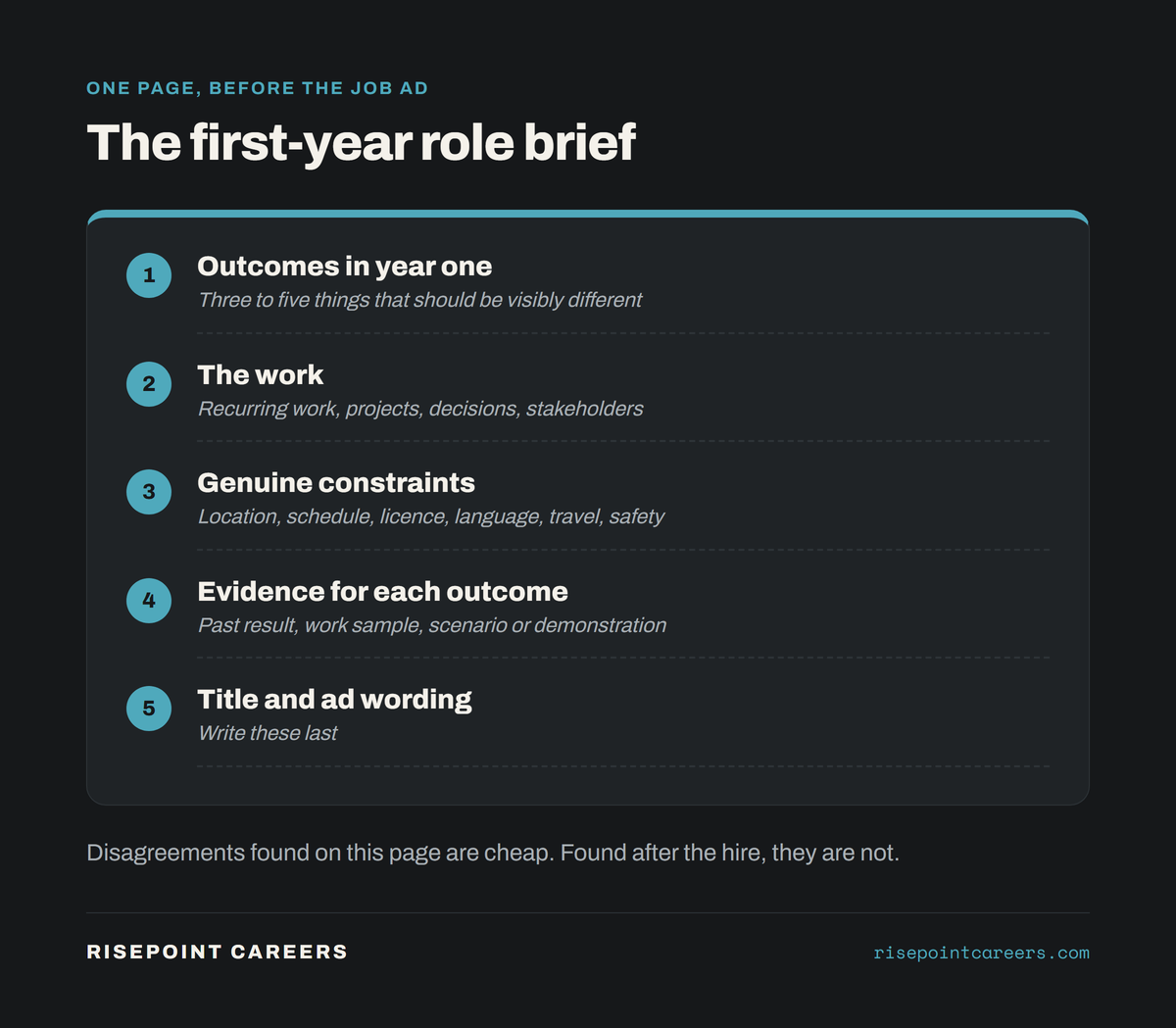
Step 1: Write three to five first-year outcomes
Start with what should be visibly different a year from now. Not tasks, but results.
For a customer success manager at a growing software company, the outcomes might be:
- Every new client is live within 30 days of signing.
- Renewals are tracked and discussed with each account at least two months before the date.
- A simple onboarding guide exists, so clients stop asking the same ten questions.
Three to five is enough. If you have twelve, some are tasks in disguise, and some may belong to a different role.
A useful test for each outcome: at the end of the year, could two people look at it and agree whether it happened? "Improve the client experience" fails that test. "Every new client is live within 30 days" passes it.
Step 2: Describe the work
Next, split the work into the four kinds we covered earlier: recurring work, projects, decisions and stakeholder interactions.
For the same role, recurring work might be weekly check-ins with accounts. A project might be building the onboarding guide. Decisions might include whether to offer a client extra training without asking a manager. Stakeholders might include the sales team, who hand over new clients, and the product team, who need to hear about problems.
This step often exposes a gap between the outcomes and the work. If no part of the work leads to one of your outcomes, either the outcome is unrealistic or the work description is incomplete.
Step 3: Add the genuine constraints
Now list what is truly fixed: location, schedule, licensing, language, travel and safety requirements.
Keep this list honest. A constraint is something the work cannot happen without, not a preference about where the person has worked before. The Ontario Human Rights Commission advises employers to list essential duties in a job description and state them clearly when advertising. The brief is where you work out what those are.
Step 4: For each outcome, name the evidence
This is the step most teams skip, and it is the one that pays off later.
For every outcome, write one form of evidence that would help you judge whether a candidate is ready. It might be:
- A previous result, such as a similar onboarding process they built elsewhere.
- A work sample, such as drafting a short onboarding email for a fictional client.
- A scenario, such as how they would handle a client who has missed two check-ins.
- A technical demonstration, such as setting up an account in a tool similar to yours.
- A structured example, such as the last time they turned around an unhappy account.
The US Office of Personnel Management uses work simulations in federal hiring because, in its words, applicants must demonstrate their skills rather than simply describe them. Even a small company can borrow the idea with a short, realistic exercise.
The University of Wisconsin Madison's recruitment planning guidance makes a related point. It describes criteria as the basis for screening rubrics, interview questions and talent pools, and says rubrics standardise evaluations to reduce bias, improve fairness and make decisions more transparent. If you know the evidence before you advertise, your screening and interviews almost design themselves.
Step 5: Only now, write the title and the ad
With the brief in hand, the title becomes easier to choose. It should describe the work in words candidates will recognise, not just repeat what the role was called last time.
The ad then has a clear structure: the outcomes, the work, the real constraints and how candidates will be assessed.
Why it is worth an hour
The biggest benefit of the brief is not the document itself. It is the conversations it forces.
A founder might expect the new hire to rebuild the onboarding process. The sales lead might expect them to take over renewals. The current team might expect someone to handle the support inbox. All three can be reasonable, but they describe different jobs. Written down on one page, the disagreement is obvious and costs an hour to resolve. Discovered three months after the hire, it costs much more.
One page, many uses
Once the brief is agreed, it does a lot of work.
- The job description comes from the outcomes, the work and the constraints.
- Sourcing is clearer, because you know which backgrounds could plausibly deliver the outcomes.
- The screening scorecard comes from the evidence for each outcome.
- Interview questions follow the same evidence. OPM's guidance on structured interviews recommends tying questions to the competencies identified through job analysis.
- Onboarding starts with the first-year outcomes, so the new hire knows what success looks like from day one.
- Performance expectations at the end of the year are already written.
The bottom line
Before you edit the job description, write one page. List three to five first-year outcomes, describe the work, add the genuine constraints, and name the evidence you will look for. Then choose the title and write the ad. It is the cheapest hour in the whole hiring process.