Read the requirements section of almost any job description and you will find a single list that looks something like this:
- Excellent communication skills
- Salesforce
- Manage onboarding for new clients
- Driving licence
- Self starter
- Reduce time to value for new accounts
Six bullets, same format, all treated as requirements. Often all six get called "skills".
They are not the same kind of thing. One is a skill. One is a tool. One is a task. One is a credential. One is a trait. One is an outcome. Each needs a different kind of evidence, and when they sit in one undifferentiated list, the people assessing candidates are left guessing what they are looking for.
In our last article we suggested starting a skills architecture with one role family. This one is about a basic piece of clarity that makes that architecture usable: knowing what kind of item each requirement is.
Six different things
A skill is a capability a person can apply, such as explaining technical products in plain language, or building a forecast from sales data.
A tool is something used to do the work: a piece of software, equipment or a method. Knowing Salesforce is not the same as being good at client relationships.
A task is an activity the role involves, such as running onboarding calls or reconciling invoices. Tasks use skills, but they are not skills themselves.
A credential is a verified qualification: a licence, a certification or a registration. O*NET, the US occupational database, treats licensing as its own category, defined as "required licenses, certifications, or registrations needed to perform a job."
A trait describes a tendency or characteristic, such as "self starter" or "detail oriented". O*NET calls these work styles, "personality tendencies exhibited at work, which can affect how well someone performs a job", and keeps them separate from skills and knowledge.
An outcome is the result the role must create, such as reducing onboarding time or growing renewals. We covered why outcomes come first in define what must change after hiring.
Why the label changes the assessment
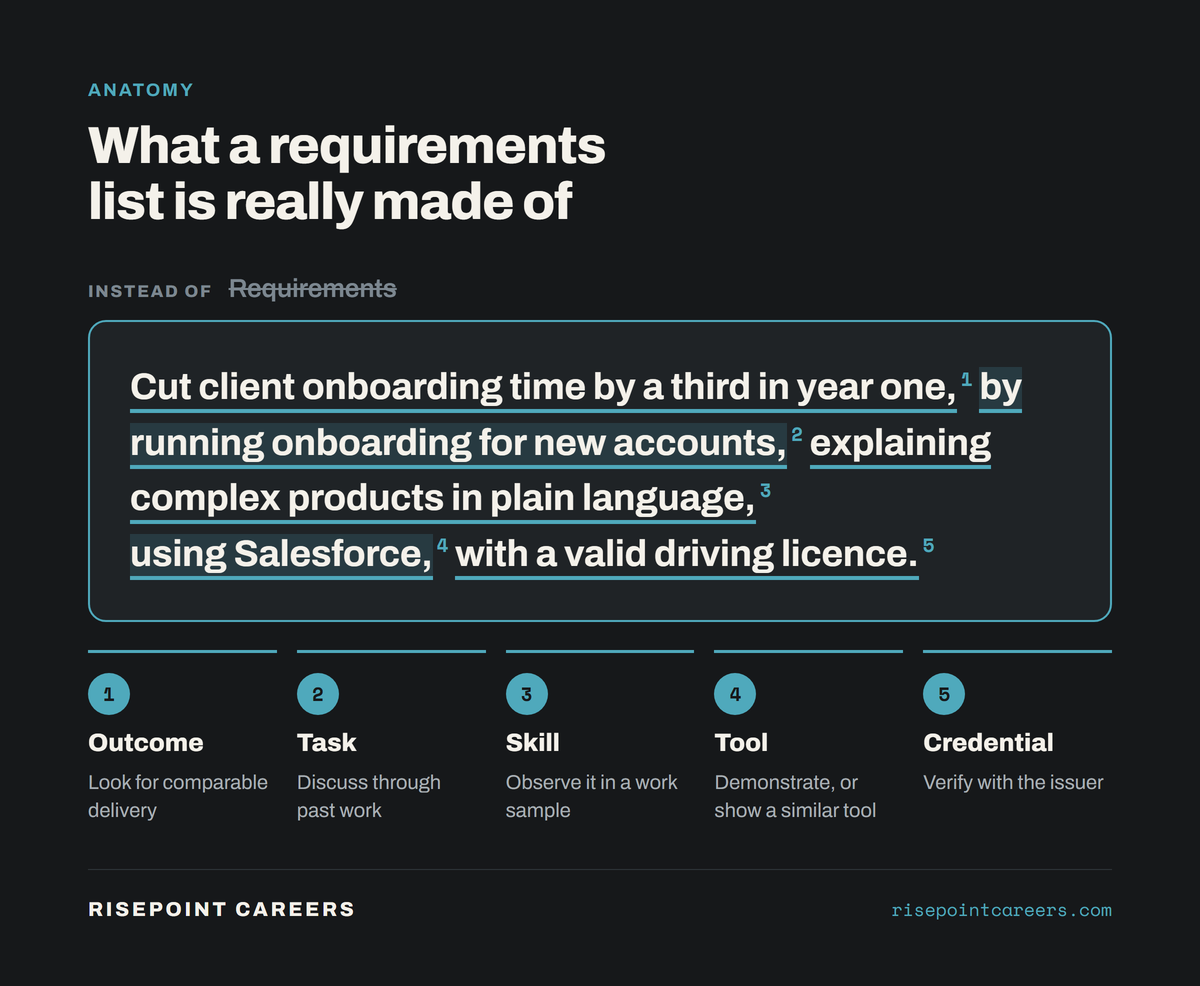
The reason to separate these is practical. Each type is checked in a different way.
- Skill: observe it in a work sample, a realistic scenario or a structured interview question.
- Tool: ask for a short demonstration, or accept a similar tool plus a sensible learning period.
- Task: discuss previous work in detail: what they did, how often, and with what result.
- Credential: verify it with the issuer. There is no need to interview for it.
- Trait: look for behaviour in past situations, and be careful, because traits are easy to judge on impressions.
- Outcome: look for comparable delivery. Have they produced a similar result somewhere else?
When everything is called a skill, reviewers apply one method to all of it. They interview for a licence that should simply be verified. They screen out someone who knows a competing tool. They score "self starter" on how confident someone seemed in a 30 minute call.
Traits deserve extra care
Traits are the hardest item on the list. They are real, and they matter. But they are rarely observable in a resume, and they are where personal impressions most easily stand in for evidence.
Where you can, translate a trait into the behaviour you actually need. "Self starter" might mean "plans their own week and flags blockers without being asked". That is something a candidate can describe with a real example, and something two interviewers can score the same way.
There is also a legal angle. The UK's Acas guidance says employers must be able to prove a good reason for any job requirement in an advert, and warns that phrases like "highly experienced" can relate to age. Vague trait language is harder to justify than a clear description of the work.
This is how the large frameworks work
Public skills frameworks make these distinctions too. O*NET separates skills and knowledge, work styles, licensing, tasks and work activities into different parts of its content model. The European Commission's ESCO classification distinguishes skill and competence concepts from knowledge concepts across about 13,500 entries.
You do not need their level of detail. But the principle is the same: different types of information are stored and used differently.
A practical way to start
You do not need a new system. Take one live job description and do this:
- Label every requirement with one of the six types: skill, tool, task, credential, trait or outcome.
- Rewrite anything vague. Turn traits into observable behaviour. Turn tasks into the skills they rely on, where that helps.
- Decide the evidence for each. Write one line on how you will check it, using the list above.
- Remove anything you cannot justify. If no one can say why a tool or credential is needed, it may be a preference, not a requirement. We looked at this in preferences written as requirements.
Once one description is labelled, the same structure carries into your interview scorecard and into the skill records you keep for candidates and employees.
The bottom line
A list where everything is called a skill is hard to read and harder to maintain. Separate skills, tools, tasks, credentials, traits and outcomes. Then assess each one with the kind of evidence that actually fits it. That clarity does not need academic complexity. It just needs reviewers to know what they are looking at.