A detailed skills taxonomy is an impressive thing to look at.
Hundreds of skills, each defined. Proficiency levels from beginner to expert. Relationships mapped between skills, roles and courses. It looks complete, and it looks precise.
The trouble is that precision on paper is not the same as accuracy about the work. The model can be well built and still describe a reality that has already moved on.
In our last article we explained why not everything in a job description is a skill. This one is about the limits of the whole structure, and how to keep it honest.
Four ways a taxonomy drifts from reality
The work changes. New tools change how tasks are done. Teams take on new responsibilities and drop old ones. LinkedIn's research found that the skill sets for jobs had changed by around 25 percent since 2015, and projected that the figure would double by 2027. A definition written two years ago may describe the job as it used to be.
Even national frameworks update in slices. O*NET, the US occupational database, publishes one scheduled release a year. Its 2026 release refreshes data for 208 occupations, not all of them. If a national database with a dedicated research team updates in stages, an internal model maintained in spare time will lag even more.
People describe their work differently. Employees use the words of their team, their last employer or their industry. The organization uses its own terms. Without care, the same capability ends up recorded under different names, or not recorded at all.
Self ratings are unreliable. Many skills systems ask people to rate themselves. Research on self assessment is not encouraging. Summarising David Dunning's review of the evidence, the Association for Psychological Science reports a study of surgical residents in which peer and supervisor ratings predicted exam performance, while the residents' own ratings showed virtually no correlation. The conclusion: other people predict our performance better than we do.
Labels need to point at work
A proficiency label such as "advanced" sounds informative. On its own, it is not.
Advanced compared with whom? Measured how? Shown when? If two managers would rate the same person differently, the label is not carrying much information.
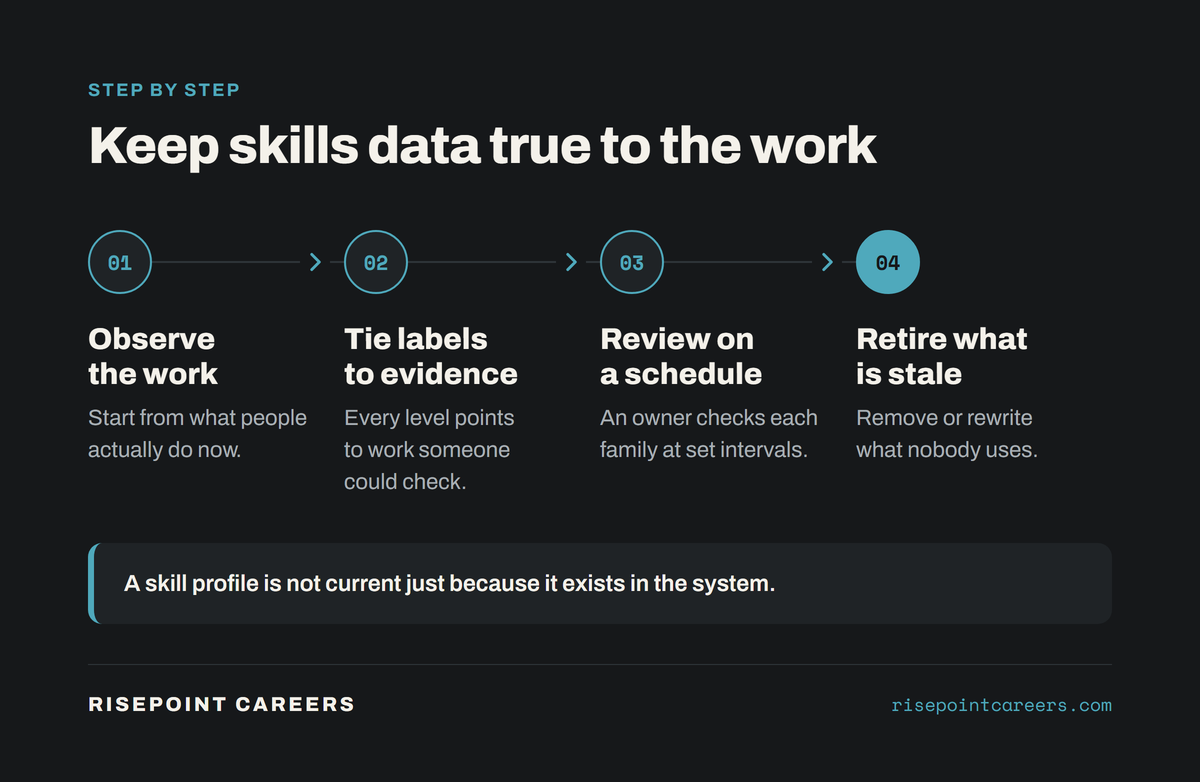
A level becomes useful when it refers to observable work. "Advanced: builds the monthly forecast independently and explains variances to the leadership team" can be checked. "Advanced" cannot. We described the fields that make this possible in what makes a skill record useful: context, level, recency and evidence.
Skills data needs stewardship
A taxonomy is not a project you finish. It is closer to a living record that someone has to look after.
Give each role family an owner. Usually a manager who knows the work, supported by HR. They are responsible for noticing when definitions no longer fit.
Review on a schedule. Once or twice a year is enough for most families. Ask which skills were used in real decisions, which caused confusion, and which nobody touched.
Prefer evidence over self report. Self ratings can be a starting point for a conversation. They should not be the final record. Add a work sample, a manager's observation or a verified credential where it matters.
Date everything. A skill record should show when it was last confirmed. A profile that has not been updated in three years should be read differently from one updated last month.
Retire as well as add. It is easy to add new skills and hard to remove old ones. A smaller model that is current is more useful than a large one that is partly fiction.
A short example
A finance team built a skills model two years ago. It lists "advanced Excel" as a core skill for analysts, and most analysts rated themselves advanced.
When a new analyst role opens, the manager looks again. The team now builds most of its reports in a business intelligence tool, and the work that matters is turning messy data into a clear story for budget holders. Nobody's profile mentions that. Several "advanced Excel" ratings belong to people who have not built a model in a year.
The manager rewrites two definitions, adds the reporting tool, and asks each analyst for one recent example. The model shrinks a little and becomes a lot more useful.
What the architecture is for
None of this means skills taxonomies are a bad idea. They are useful. They improve comparison between people and roles, make hidden capability more visible, and give hiring, learning and planning a shared language.
But they do not remove uncertainty. A good architecture helps people ask better questions: does this candidate show evidence of this capability, at this level, recently? It should leave room for context, verification and change, not pretend to have settled them.
A quick health check
Pick one role family and ask:
- When was each skill definition last reviewed?
- How many skill records are self rated only, with no other evidence?
- Which skills have not appeared in a single hiring, promotion or learning decision in the last year?
- Would two managers give the same person the same level?
If the answers are "not sure", the model is describing a version of the work that may no longer exist. That is the place to start, as we suggested in start with one role family.
The bottom line
A detailed taxonomy can look precise while the work changes underneath it. Tie every label to observable work, prefer evidence to self ratings, give each family an owner and review it regularly. The aim is not a perfect model. It is a model that stays close enough to reality to support better decisions.